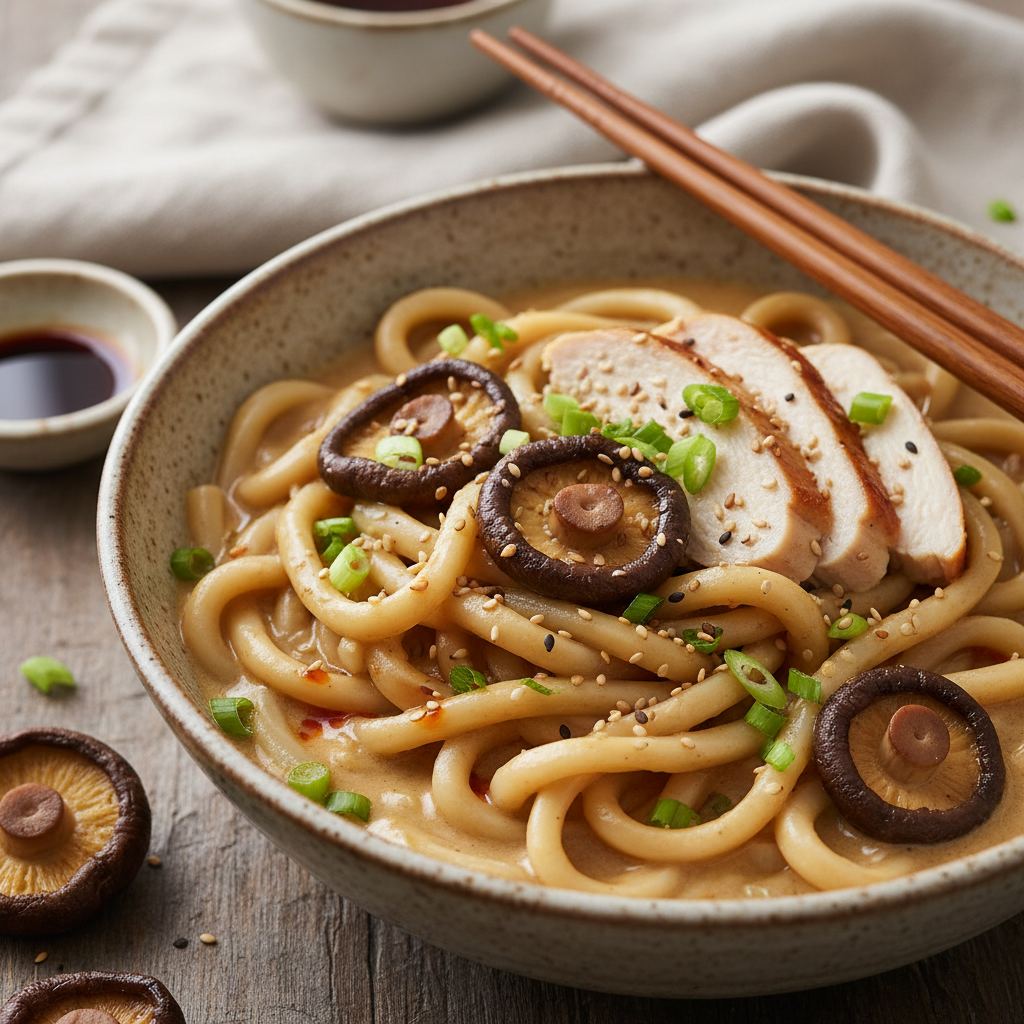
Homemade Udon Noodles in Creamy Miso Sauce with Chicken and Shitake Mushrooms

Pikantne Asian cuisine Main Dishes Pasta and Risotto 150 min Medium 34 wyświetleń ~50.83 PLN - (0)
Rate:
(0)
Start Cooking

Description

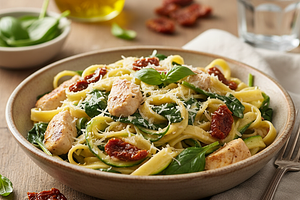
Discover the secret to perfectly chewy, thick Japanese Udon noodles that you can make entirely from scratch in your own kitchen. This recipe is a complete culinary journey – from kneading the dough using a traditional, surprising method to creating a velvety, deeply flavored sauce based on miso paste, dashi broth, and cream. The dish combines the essence of Japanese umami with a creamy, enveloping texture. Juicy, grilled chicken marinated in soy sauce and ginger, along with meaty shiitake mushrooms, perfectly complement the whole. Visually, the dish delights with the contrast of the white noodles, deep beige sauce, and colorful toppings – green onions and optionally, a vibrant orange egg yolk. This dish is perfect for a special dinner when you want to impress your guests or simply immerse yourself in the meditative process of creating something extraordinary from scratch.

Ingredients (18)

Servings:
4
  • Mąka pszenna typ 450 lub 500 500 g
  • Ciepła woda 230 ml
  • Chicken breast 500 g
  • fresh shiitake mushrooms 200 g
  • Light miso paste (shiro) 4 łyżki
  • Dashi broth 500 ml
  • Light soy sauce 45 ml
  • Mirin 30 ml
  • Sesame oil 15 ml
  • Garlic 2 ząbki
  • Fresh ginger 15 g
  • Green onion 2 pęczki
  • 30% cream 100 ml
  • Rapeseed oil 30 g
  • 🌿 Przyprawy
  • Sól morska drobnoziarnista 5 łyżeczek
  • ✨ Opcjonalne
  • Egg 4 szt.
  • White sesame 2 łyżeczki
  • Chili flakes (shichimi togarashi) 2 szczypty
💰 Szacowany koszt dania: ~50.83 PLN (12.71 PLN/porcję)

💡 Kliknij na składnik aby oznaczyć jako użyty

Preparation steps

Udon Noodle Dough

1

In a large, wide bowl, place the sifted flour. In a separate container (e.g., a jug), pour in warm water and add salt. Stir vigorously with a spoon until all the salt is completely dissolved. It is very important that there are no salt crystals in the dough. Gradually, in three batches, pour the salty water into the flour, mixing each time with your hand or a wooden spoon to allow the flour to absorb the liquid. After adding all the water, start kneading the ingredients in the bowl until they come together into a rough and fairly firm ball of dough. Don't worry if the dough is lumpy at this stage - that's normal.

Ingredients: Mąka pszenna typ 450 lub 500, Sól morska drobnoziarnista, Ciepła woda
Use a large bowl to have freedom of movement. Sifting the flour will aerate it and make it easier to combine with water. Make sure the water is not hot; it should be at a temperature comfortable for your hands.
2

Transfer the ball of dough to a clean kitchen surface. Do not dust with flour! Start kneading the dough using the heel of your hand. Press the dough into the surface, pushing it away from you, then fold it in half and turn it 90 degrees. Repeat this motion for about 5 minutes. The dough will be very stiff and resistant, but over time it will become a bit more elastic. Shape it into a ball, place it in a bowl, cover with a damp cloth, and let it rest for 15 minutes to allow the gluten to start working.

Kneading this dough requires strength. Don't be discouraged by its firmness. A short rest will make further kneading easier.
3

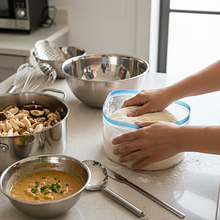
Get ready for a traditional Japanese technique. Take a large, sturdy ziplock bag (e.g., for freezing) and place the ball of dough inside. Seal the bag, removing as much air as possible. Place the bag on the floor, on a clean towel. Put on clean socks and step onto the bag. Start to stomp on the dough, distributing your body weight evenly. Do this for about 5-7 minutes, until the dough becomes a flat disc. Remove the dough from the bag, fold it into three layers (like a letter), reshape it into a ball, put it back in the bag, and repeat the stomping for another 5 minutes. The dough should become smooth and elastic.

This method, although unconventional, is the key to achieving the perfect Udon texture. The pressure from your legs is much greater than that of your hands, allowing you to knead the tough dough perfectly. Use two bags if you're concerned about its durability.
4

Remove the dough from the bag, shape it into a smooth ball, place it in a bowl, cover it tightly with plastic wrap, and let it sit at room temperature for at least 1 hour, preferably 2-3 hours. During this time, the gluten in the dough will fully relax, making it easy to roll out and elastic after cooking.

Do not shorten the resting time! This is a key step that determines the final quality of the pasta. You can also place the dough in the refrigerator overnight.

Shaping Udon Noodles

5

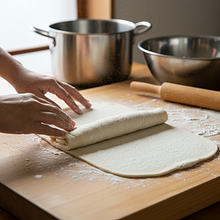
After resting, the dough will be soft and easy to roll out. Transfer it to a lightly floured surface. Flatten it with your hand, then start rolling from the center outward, regularly turning the dough 90 degrees. Roll until you achieve a rectangle about 3-4 mm thick. Try to keep the thickness even across the entire surface.

Ingredients: Mąka pszenna typ 450 lub 500
Use a long, heavy rolling pin. If the dough is sticky, sprinkle the surface and the rolling pin with a little flour, but not too much, so that the pasta doesn't become too hard.
6

Dust the surface of the rolled-out dough generously with flour and rub it with your hand. Fold the dough like an accordion (or like a letter) in three or four layers. Make sure each layer is well dusted with flour so they don’t stick together. Now take a very sharp, long knife and start cutting the folded dough into strips about 3-4 mm wide. Try to cut in one decisive motion from top to bottom.

Ingredients: Mąka pszenna typ 450 lub 500
Use a chef's knife or cleaver. A dull knife will crush the dough instead of cutting it. A stable cutting board is essential.
7

Gently unfold the cut strips of pasta. Hold them in your hands and give them a slight shake to let the excess flour fall off and to separate the strands. Arrange the pasta loosely on a floured tray or countertop, forming loose 'nests'. You can cook it right away or cover it with a cloth and store it for up to an hour.

Do not squeeze the pasta. It needs space so it doesn't stick together before cooking. If you are preparing it in advance, you can freeze the raw portions.

Preparation of the Sauce and Accompaniments

8

Clean the chicken breasts and pat them dry with a paper towel. In a bowl, mix 2 tablespoons of soy sauce (30g), 1 tablespoon of mirin (15g), grated ginger, and one clove of garlic pressed through a garlic press. Place the chicken in the marinade and coat it thoroughly. Set aside for at least 20 minutes at room temperature.

Ingredients: Chicken breast, Light soy sauce, Mirin, Fresh ginger, Garlic
You can use a small grater or a spoon to scrape the ginger. Marinating will make the meat juicier and more aromatic.
9

Meanwhile, prepare the remaining ingredients. Clean the shiitake mushrooms with a damp cloth (do not wash under water!) and slice them into pieces about 0.5 cm thick. Chop the spring onion, separating the white part from the green. Slice the white part into thin pieces and cut the green part at a slight angle into longer pieces. Finely chop the remaining clove of garlic.

Ingredients: fresh shiitake mushrooms, Green onion, Garlic
Mushrooms absorb water like a sponge, so it's better to clean them dry or with a damp cloth. Separating the parts of the scallion allows you to use the white part for frying (for flavor) and the green part for decoration (for freshness and crunch).
10

Heat a large skillet (preferably a grill pan) over medium-high heat. Once hot, add a tablespoon of canola oil. Remove the chicken from the marinade, allowing the excess to drip off. Cook for 5-7 minutes on each side until golden brown and fully cooked through. Transfer to a cutting board and let rest for 5 minutes to allow the juices to settle, then slice into 1 cm thick pieces.

Ingredients: Chicken breast, Rapeseed oil
Do not move the chicken for the first 3-4 minutes of frying to achieve nice, caramelized grill marks. Letting the meat rest after frying is key to retaining its juiciness.
11

In the same pan (or in a deep pot), heat another tablespoon of oil. Add the chopped shiitake mushrooms and sauté on high heat for 4-5 minutes until they are browned and softened. Towards the end of cooking, add the minced garlic and the white part of the spring onion, and sauté for another minute until they release their aroma.

Ingredients: fresh shiitake mushrooms, Rapeseed oil, Garlic, Green onion
Do not overcrowd the pan with mushrooms - fry them in batches if necessary. This way they will fry instead of steam, resulting in better flavor and texture.
12

Reduce the heat of the burner. In a small bowl, mix the miso paste with a few tablespoons of hot dashi broth until a smooth paste without lumps forms. Add the remaining broth, the remaining soy sauce (1 tablespoon), and mirin (1 tablespoon). Pour everything into the pan with the mushrooms. Bring to a boil, then reduce the heat and simmer for 2-3 minutes.

Ingredients: Light miso paste (shiro), Dashi broth, Light soy sauce, Mirin
Dissolving miso in a small amount of liquid prevents lumps from forming in the sauce. Do not cook miso for too long over high heat, as it will lose its valuable properties and delicate aroma.
13

Into the simmering sauce, pour in the 30% cream and sesame oil. Gently mix and heat for another 1-2 minutes, until the sauce thickens slightly. Do not bring to a boil. Taste and season with a pinch of salt or a little soy sauce if needed. Remove from heat and keep warm.

Ingredients: 30% cream, Sesame oil
Adding cream at the end and avoiding boiling will prevent it from curdling. Sesame oil added at the end will retain its full, nutty aroma.

Cooking and Serving

14

In a large pot (minimum 5 liters), bring salted water to a boil. When the water is boiling vigorously, add the prepared Udon noodles. Gently stir with a wooden stick or fork to prevent the strands from sticking together. Cook for about 8-12 minutes, depending on the thickness of the noodles. It's best to fish out one strand after 8 minutes and taste it. The noodles should be cooked but still very elastic and 'meaty' (al dente).

Use a really large pot with plenty of water. Udon noodles release a lot of starch while cooking and need space to cook evenly.
15

Drain the pasta in a colander and immediately rinse it under very cold water. You can also submerge the colander in a bowl of water and ice. Gently rub the pasta with your hands under the cold water stream to remove excess starch from its surface. This step is absolutely crucial – shocking in cold water stops the cooking process and gives Udon noodles their characteristic, perfectly chewy and smooth texture.

Don't skip this step! It's the secret to perfect Udon. Rinsing removes stickiness and makes the noodles more 'firm' and enjoyable to eat.
16

Carefully drained, blanched pasta transfer directly to the warm miso sauce with mushrooms. Gently mix using tongs or chopsticks to ensure all the pasta is coated with the sauce. Heat together for a minute to warm the pasta through.

If the sauce is too thick, you can add a little bit of the water in which the pasta was cooked to thin it out.
17

Divide the pasta with the sauce into four deep bowls. Top each portion with slices of grilled chicken. Generously sprinkle with chopped green parts of the scallions. If using toppings, add half a boiled egg, sprinkle with toasted sesame seeds and chili flakes. Serve immediately while the dish is hot.

Ingredients: Egg, White sesame, Chili flakes (shichimi togarashi), Green onion
Deep bowls (like ramen-bachi) best retain the heat of the dish. It is best to use chopsticks for noodles and a spoon for the sauce.

Fun Fact

💡

Traditional kneading of Udon dough with feet is called 'ashi-fumi'. This technique allows for an even distribution of immense pressure, which is impossible to achieve by hand and is crucial for developing a hard, low-hydration dough that results in the characteristic 'koshi' texture – the perfect combination of firmness and elasticity.

Best for

Tips

🍽️ Serving

Serve the dish in deep, heated bowls to keep the temperature as long as possible. Use chopsticks and a ceramic spoon (renge) to scoop up the delicious sauce. Japanese green tea such as sencha, genmaicha, or chilled Asahi or Sapporo beer pairs perfectly as a drink.

🥡 Storage

It is best to eat the finished dish immediately. If there are leftovers, store the pasta separately from the sauce in the fridge for up to 2 days. Raw, uncooked Udon noodles can be stored in the fridge for up to 3 days (tightly wrapped in plastic) or frozen in portions for up to 1 month (cook without thawing, extending the time by 2-3 minutes).

📸 Ugotowane przez społeczność

Zaloguj się, aby dodać zdjęcie
Dodaj zdjęcie gotowej potrawy

Po zatwierdzeniu przez moderatora otrzymasz 10 punktów doświadczenia.

🍲

Nikt jeszcze nie dodał zdjęcia. Bądź pierwszy!

Comments (0)

Be the first to comment on this recipe!

Add a comment

You might also like

Recipe Categories

Asian cuisine is a variety of flavors from Japan to Thailand - umami, sweet-sour, and spicy. Sushi, ramen, pad thai, pho, and dim sum - iconic dishes from restaurants at home. Wok cooking: stir-fry with vegetables, tofu, and meat in just a few minutes. Asian sauces: soy, fish, oyster, and hoisin ...

See all recipes in this category
Main Dishes
Main Dishes in: Christmas Eve Dinner

Main courses are the heart of every meal - hearty, delicious, and full of nutrients. Meats: beef, pork, poultry, and lamb in various versions. Fish and seafood: baked, fried, grilled, and stewed. Vegetarian dishes: tofu, tempeh, legumes as the main protein. Casseroles: pasta, potato, vegetable wi...

See all recipes in this category

Pasta and risotto are Italian classics loved by the whole world - creamy, hearty, and delicious. Pasta carbonara, bolognese, puttanesca, arrabiata, and cacio e pepe - sauces with tradition. Fresh homemade pasta: tagliatelle, fettuccine, and ravioli with handmade dough. Meat and vegetarian lasagna...

See all recipes in this category

Lunches are the main meal of the day - filling, balanced, and full of flavor. Traditional two-course lunches: soup and a main dish in Polish tradition. Pork chop with potatoes and cabbage - a classic of Polish lunches. Dumplings with meat, cheese, and fruit - hand-formed delicacies. Beef goulash,...

See all recipes in this category

Dishes for special occasions are culinary masterpieces for birthdays, anniversaries, and holidays. Grilled beef steak with herb butter - restaurant quality at home. Beef Wellington - beef in puff pastry with duxelles. Roast duck with apples - a holiday tradition in a new edition. Pink salmon with...

See all recipes in this category
Reklama