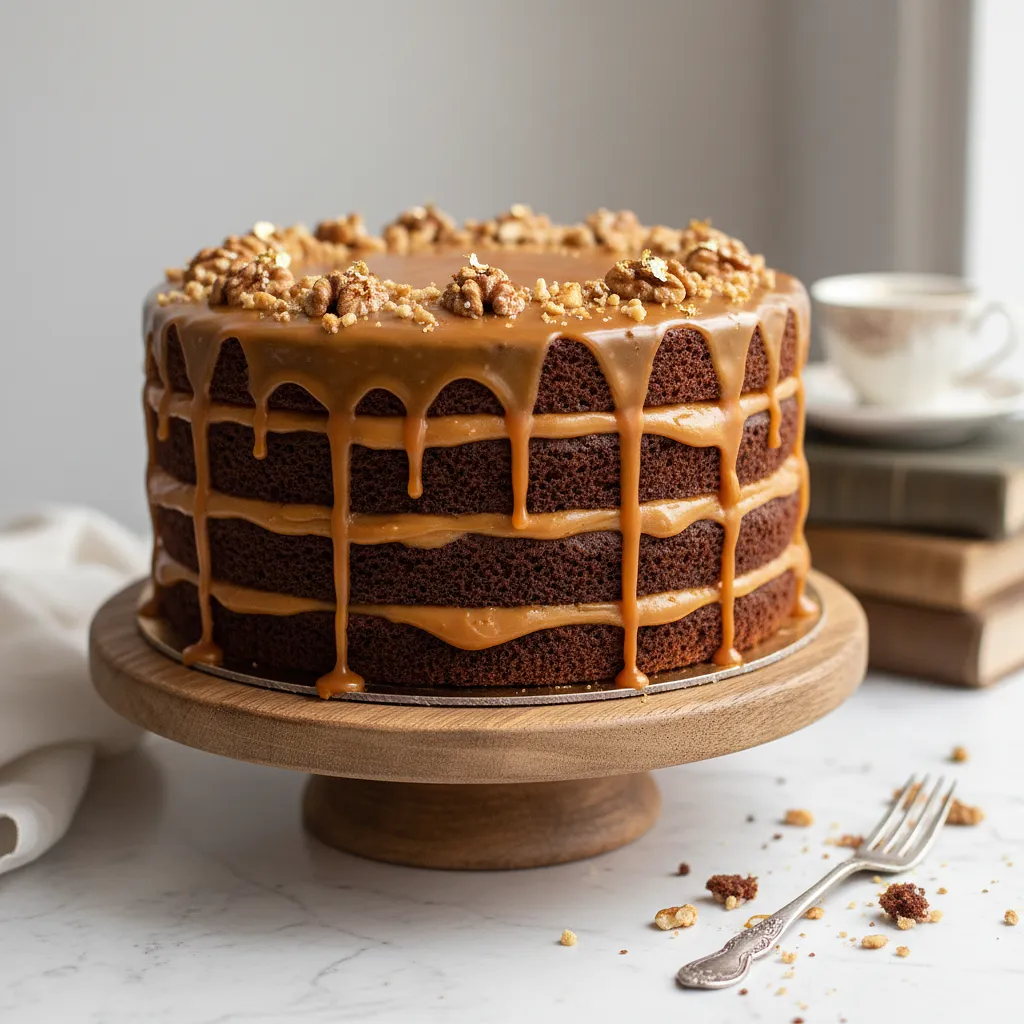
Spartak Cake 'Caramel Night'

Cakes and Bakes Desserts Dishes for Special Occasions 180 min Hard 37 wyświetleń ~71.74 PLN - (0)
Rate:
(0)
Start Cooking

Description

The 'Spartak' cake in the 'Caramel Night' version is a refined interpretation of the classic Eastern European honey cake. It consists of eight incredibly thin, intensely chocolate layers, whose deep flavor comes from the addition of real honey and the highest quality cocoa. The layers, once baked crisp, become wonderfully soft and moist under the influence of the cream, creating a harmonious whole. Breaking the savory layers is a velvety, slightly sweet cream based on mascarpone cheese and condensed milk, with a subtle hint of coffee and rum that adds elegance to the dessert. The entire cake is topped with a glossy dark chocolate glaze, flowing appetizingly down the sides. The cake looks stunning, and its cross-section in black and white stripes is extremely impressive. Perfect for special occasions when we want to impress guests with a dessert of complex, multi-dimensional flavor.

Ingredients (15)

Servings:
12
  • Mąka pszenna tortowa typ 450 500 g
  • Masło 82% 100 g
  • Cukier drobny 150 g
  • wildflower honey 100 g
  • Egg 2 szt.
  • Baking soda 10 g
  • Serek mascarpone 500 g
  • Sweetened condensed milk 300 ml
  • Strong espresso coffee 50 ml
  • Dark chocolate 70% 150 g
  • 30% cream 150 ml
  • 🌿 Przyprawy
  • Kakao ciemne 50 g
  • Salt 0.0 szczypt
  • ✨ Opcjonalne
  • Dark rum 2 łyżki
  • Walnuts 30 g
💰 Szacowany koszt dania: ~71.74 PLN (5.98 PLN/porcję)

💡 Kliknij na składnik aby oznaczyć jako użyty

Preparation steps

Honey-Chocolate Cake

1

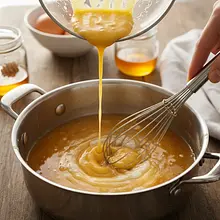
Prepare a water bath. Pour water into a pot to a height of about 3-4 cm and bring it to a boil. Reduce the heat so that the water is just gently 'bubbling'. Place a metal or glass bowl on top of the pot that is larger than the diameter of the pot and does not touch the surface of the water. In the bowl, add the diced butter, sugar, and honey.

Ingredients: Masło 82%, Cukier drobny, wildflower honey
A water bath (bain-marie) is essential as it allows for gentle and even heating of the ingredients without the risk of burning. Make sure that steam does not get into the bowl.
2

Mix the ingredients in a bowl using a whisk until the butter and sugar are completely dissolved and the mixture becomes smooth and liquid. This should take about 5-7 minutes. In the meantime, in a small bowl, lightly beat the eggs with a fork.

Ingredients: Egg
Patience is key. Do not increase the heat to speed up the process. The mixture must be smooth, without any detectable sugar crystals.
3

Very slowly, in a thin stream, pour the beaten eggs into the hot honey mixture, constantly whisking vigorously. This is a very important moment - continuous mixing will prevent the eggs from curdling and turning into scrambled eggs. Mix for another 1-2 minutes, until the mixture thickens slightly.

Ingredients: Egg
If you're worried that the eggs will curdle, you can remove the bowl from the water bath while adding the eggs, and then place it back on the pot.
4

Add baking soda to the hot mixture and stir for about a minute. The mixture will rapidly increase in volume and become very fluffy and frothy. This is the correct reaction. Remove the bowl from the water bath.

Ingredients: Baking soda
Use a bowl of appropriate size so that the foam doesn't 'escape'. The reaction of baking soda with warm, acidic honey aerates the dough.
5

In a separate, large bowl, mix the sifted flour, cocoa powder, and a pinch of salt. Sifting is important to aerate the ingredients and eliminate lumps. Make a well in the center and pour in the hot, frothy honey mixture.

Ingredients: Mąka pszenna tortowa typ 450, Kakao ciemne, Salt
Use a fine mesh sieve to sift the flour and cocoa powder. This will ensure the cake has a uniform texture.
6

Using a wooden spoon or spatula, start mixing the ingredients, folding the dry into the center until they are initially combined. When the dough has cooled slightly, transfer it to a work surface and briefly knead it by hand, just until you achieve a uniform, smooth ball. The dough will be soft and slightly sticky – this is normal.

Do not knead the dough too long, or it will become tough. It should have the consistency of warm playdough. Do not add too much flour, even if it is sticky.
7

Shape the dough into a disk, wrap it tightly in plastic wrap, and place it in the refrigerator for at least 1 hour. Chilling the dough will make it firm and much easier to roll out.

You can prepare the dough the day before and leave it in the fridge overnight. This will make it easier to organize your work.
8

Preheat the oven to 180°C (fan). Take the chilled dough out of the fridge, unwrap it from the foil, and divide it into 8 equal parts using a kitchen scale or by eye. Shape each part into a ball. Keep the parts you are not currently using covered to prevent them from drying out.

Using a kitchen scale ensures that all layers will have the same thickness and will bake evenly.
9

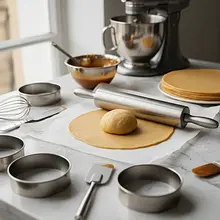
Take one ball of dough and place it on a sheet of parchment paper. Roll it out into a very thin circle, about 1-2 mm thick. The dough is flexible, but roll it gently. Immediately on the paper, place a plate or the bottom of a springform pan with a diameter of 22-24 cm and cut out a perfect circle with a sharp knife. Do not remove the scraps!

Rolling directly on parchment paper is the best way. You will avoid problems with transferring the thin crust to the baking sheet. The scraps baked together with the base will be used for decoration.
10

Prick the dough thoroughly with a fork all over the surface. This will prevent air bubbles from forming during baking. Transfer the paper with the dough and scraps onto a large baking sheet.

Do not skip the pricking! This will ensure that the layers are flat and even, which is crucial when assembling the cake.
11

Place the baking sheet in the preheated oven and bake each layer for 5-7 minutes. The finished layer will be matte and dry to the touch. Be careful not to burn it. The hot layer is soft, but it hardens very quickly once removed. Move the parchment with the baked layer to a cooling rack. Repeat the process for all 8 pieces of dough. Collect all the baked scraps in a bowl.

The layers bake very quickly, so keep an eye on the oven. Stack the baked layers on top of each other, placing parchment paper between them to prevent them from breaking. They are very fragile!

Coffee cream with mascarpone

12

In a mixing bowl, place the well-chilled mascarpone cheese. Using the whisk attachment, mix it on medium speed for about 30 seconds, just until it becomes smooth and creamy. Do not mix for too long!

Ingredients: Serek mascarpone
Beating mascarpone for too long, especially at room temperature, can cause it to curdle. It's only about 'breaking' its dense structure.
13

Reduce the mixer speed to the minimum and add the chilled condensed milk in a thin stream while continuously mixing. Once all the milk has been added, increase the speed to medium and mix for another 1-2 minutes until the cream becomes thick, fluffy, and stable.

Ingredients: Sweetened condensed milk
Slowly adding the condensed milk prevents the cream from thinning and allows for perfect aeration.
14

Finally, add the completely cooled coffee and optionally rum. Gently mix with a spatula or on the lowest speed of the mixer, just until the ingredients are combined. The finished cream should be thick and smooth. Place it in the refrigerator while preparing the topping.

Ingredients: Strong espresso coffee, Dark rum
The coffee must be cold; otherwise, the warm liquid will dissolve the fat in the mascarpone and the cream will curdle. Do not mix for too long to prevent the cream from losing its fluffiness.

Chocolate Glaze (Ganache)

15

Break the chocolate into small pieces and place them in a heatproof bowl. In a small saucepan, heat the heavy cream until it is very hot, but do not bring it to a boil (small bubbles will appear at the edges).

Ingredients: Dark chocolate 70%, 30% cream
Use good quality chocolate, as it is responsible for the flavor of the glaze. Even, small pieces will melt at the same time.
16

Pour the hot cream over the pieces of chocolate. Do not stir! Set the bowl aside for 3-4 minutes. The heat of the cream will melt the chocolate. After this time, start gently mixing the mixture with a small whisk or spatula, beginning from the center of the bowl and making small, circular motions. Gradually expand the movements to the entire bowl until a smooth, shiny, and uniform glaze is formed.

Patience when mixing the ganache is key to achieving the perfect emulsion. Vigorous mixing right away can cause the glaze to separate.

Assembling the cake

17

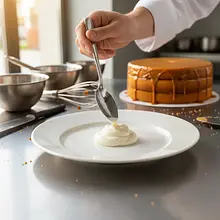
Prepare a platter or plate on which you will serve the cake. Place a small teaspoon of cream in the center (this will prevent the first layer from sliding). Place the first chocolate layer on top. Spread an even layer of cream on it (about 2-3 full tablespoons). Cover with the second layer, pressing down gently.

Use a kitchen scale to divide the cream into 8 equal parts (7 for layering and 1 for the top/sides). This will ensure even layers. A small spatula is perfect for spreading.
18

Repeat the process, alternating layers and cream until all ingredients are used up. Place the last, eighth layer on top. Use the remaining cream to thinly coat the top and sides of the cake. This layer is called a 'crumb coat' and 'seals' in all the crumbs.

Don't worry if the sides aren't perfectly smooth - they will be covered with crumbs. Gently pressing each layer is important for the cake to be stable.
19

Place the assembled cake in the refrigerator for at least 30-60 minutes to allow the cream to set. During this time, prepare the crumbs for decoration. Place the previously baked cake scraps in a sturdy ziplock bag and crush them with a rolling pin into fine 'sand'.

You can also use a food processor to quickly chop the scraps. Chilling the cake before applying the frosting is crucial for the ganache to set nicely and not drip too quickly.
20

Take the chilled cake out of the refrigerator. Pour the ganache glaze, which should still be liquid but no longer hot (at body temperature), into the center of the cake. Gently tilting the stand or using a spatula, spread the glaze so that it covers the entire top and begins to drip down the sides in an irregular manner, creating a 'drip' effect.

If the ganache has thickened too much, you can heat it in the microwave for 5-10 seconds. Do not pour the hot glaze, as it will melt the cream.
21

Before the glaze completely sets, sprinkle the sides of the cake with the crumbs you prepared earlier. You can do this by gently 'pressing' the crumbs with your hand against the sides of the cake. Additionally, you can decorate the top of the cake with chopped walnuts.

Ingredients: Walnuts
The easiest way to coat the sides is to place the cake on a rack, with a large plate or parchment paper underneath to catch any excess crumbs.
22

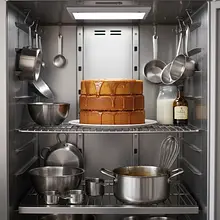
Place the finished cake in the refrigerator for at least 12 hours, preferably for a full day (24 hours). This is the most important step, during which the hard and crumbly layers will absorb moisture from the cream, becoming wonderfully soft and melting in your mouth. The flavors will blend perfectly.

Do not shorten the cooling time! A cake eaten the same day will be hard and disappointing. The real magic of this cake happens in the fridge overnight.

Fun Fact

💡

The name 'Spartak' likely refers to Spartacus, the Roman gladiator, symbolizing strength and bold flavor. Cakes with a similar structure (thin honey layers filled with cream) are extremely popular throughout Eastern Europe, and each family has its own unique recipe for 'Medovik' (honey cake) or 'Spartak'.

Best for

Tips

🍽️ Serving

The cake tastes best well chilled, straight from the fridge. For cutting, use a long, sharp knife dipped for a moment in boiling water and dried. This will allow you to achieve perfectly smooth and even pieces without smearing the cream. Serve with a cup of strong black coffee or tea to balance the sweetness of the dessert.

🥡 Storage

Store the cake in the refrigerator, in an airtight cake container, to prevent it from absorbing odors. It retains freshness and excellent flavor for 3-4 days. Interestingly, many believe that on the second and third day after preparation, it tastes even better, as the flavors fully meld together.

📸 Ugotowane przez społeczność

Zaloguj się, aby dodać zdjęcie
Dodaj zdjęcie gotowej potrawy

Po zatwierdzeniu przez moderatora otrzymasz 10 punktów doświadczenia.

🍲

Nikt jeszcze nie dodał zdjęcia. Bądź pierwszy!

Comments (0)

Be the first to comment on this recipe!

Add a comment

You might also like

Recipe Categories

Homemade cakes and pastries are the heart of Polish culinary tradition - sweet memories from childhood. In our collection, you will find recipes for classic yeast cakes, shortcrust, sponge, and cheesecake. Apple pie, poppy seed cake, gingerbread, Easter babka, chocolate cake, and New York cheesec...

See all recipes in this category
Desserts
Desserts in: Christmas Eve Dinner

Desserts are a sweet ending to a meal that brings joy to both children and adults. In this category, we present recipes for a variety of sweets - from simple creams and mousses, to elegant panna cottas, and exquisite fruit tarts. Our desserts include both classics of Polish cuisine - fruit jelly,...

See all recipes in this category

Dishes for special occasions are culinary masterpieces for birthdays, anniversaries, and holidays. Grilled beef steak with herb butter - restaurant quality at home. Beef Wellington - beef in puff pastry with duxelles. Roast duck with apples - a holiday tradition in a new edition. Pink salmon with...

See all recipes in this category
Reklama