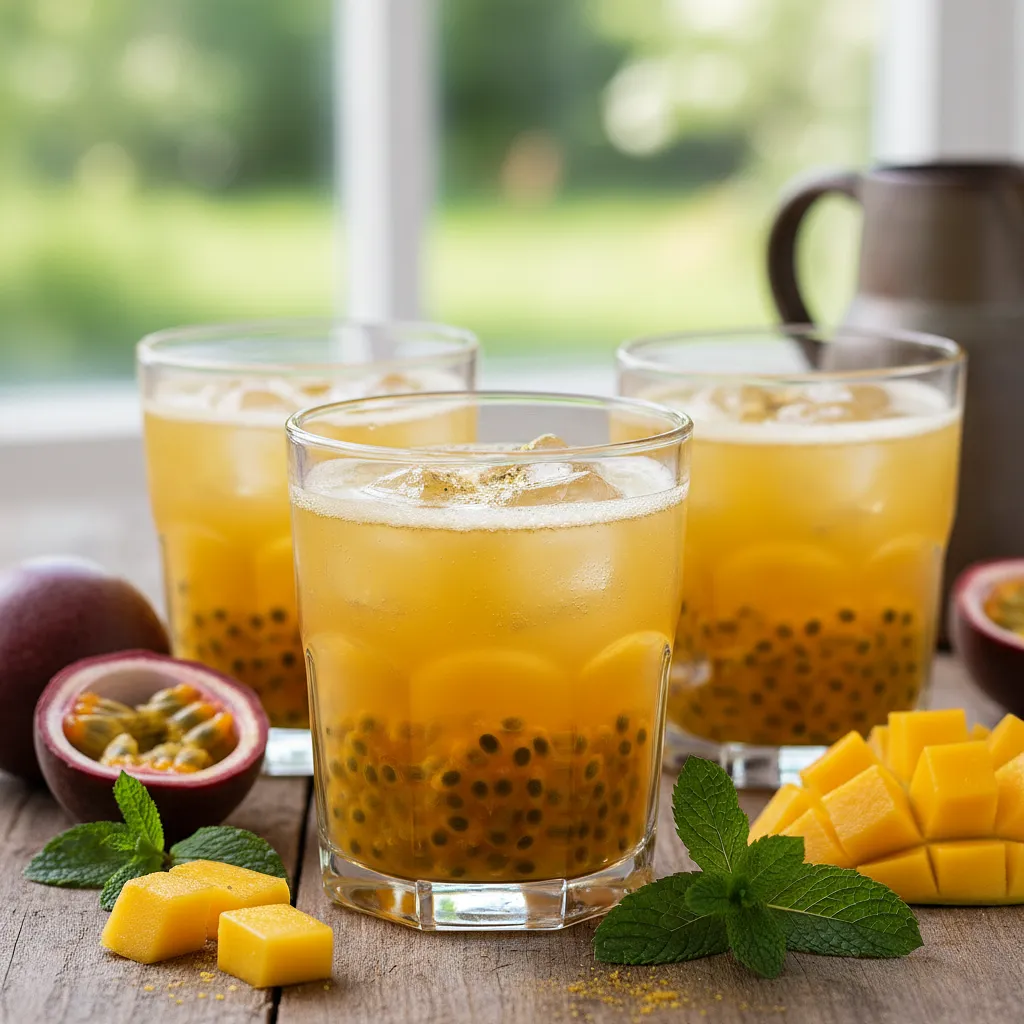
Homemade Caviar from Fruit Juice with Mango and Passion Fruit Flavor

Vegan Desserts Desserts for Kids Dishes for Special Occasions 90 min Medium 13 wyświetleń ~16.08 PLN - (0)
Rate:
(0)
Start Cooking

Description

Discover the magic of molecular cuisine in your home! This recipe is your ticket to the world of modern gastronomy, allowing you to create spectacular, small pearls full of intense tropical fruit flavor. Homemade mango and passion fruit caviar is nothing more than gel-like spheres that burst in your mouth, releasing a liquid, fruity interior. This technique, called spherification, although it sounds complicated, is surprisingly easy to master. The finished pearls have a beautiful amber color and make a stunning decoration for desserts such as panna cotta, cheesecakes, ice creams, or mousses. They can also be added to yogurt, granola, or even prosecco or other cocktails, creating a striking and delicious 'bubble drink.' It's the perfect way to impress your guests and turn an ordinary meal into a culinary work of art.

Ingredients (7)

Servings:
4
  • Vegetable oil (sunflower or rapeseed) 500 ml
  • Mango juice (thick nectar or purée) 250 ml
  • Passion fruit juice 100 ml
  • Agar-agar 4 g
  • White sugar 30 g
  • ✨ Opcjonalne
  • Lemon juice 15 ml
  • Edible gold dust 1 szczypta
💰 Szacowany koszt dania: ~16.08 PLN (4.02 PLN/porcję)

💡 Kliknij na składnik aby oznaczyć jako użyty

Preparation steps

Preparing the oil

1

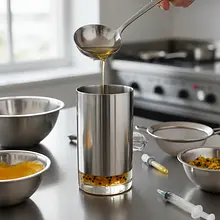
Pour all the vegetable oil into a tall, narrow container, such as a glass with a capacity of 500-700 ml or a laboratory beaker. The height of the container is important because the droplets of juice need time to fall and solidify into balls. Place the container with the oil in the freezer for at least 60 minutes. The oil will not freeze, but it will become very thick and icy to the touch. This is crucial for the success of the recipe.

Ingredients: Vegetable oil (sunflower or rapeseed)
Use a container that is stable and transparent – this way you will see the forming pearls. The oil must be really cold! If it is not chilled enough, the droplets will spread out at the bottom instead of solidifying into balls.
Preparation of the fruit base

2

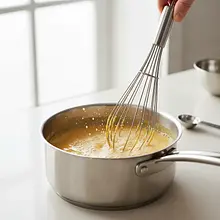
In a small saucepan, combine mango juice, passion fruit juice, and sugar. If using, also add lemon juice now. Mix everything thoroughly with a small whisk or spoon to help the sugar start dissolving.

Ingredients: Mango juice (thick nectar or purée), Passion fruit juice, White sugar, Lemon juice
Use a heavy-bottomed saucepan to prevent the mixture from sticking and burning while heating. At this stage, the liquid does not need to be heated.
3

Into the cold mixture of juices, sprinkle the agar-agar powder. Using a whisk, mix vigorously for about a minute. Make sure there are no lumps. The agar must be evenly distributed in the cold liquid before you start heating it, otherwise, difficult-to-break gel lumps will form.

Ingredients: Agar-agar
This is the most important step to avoid lumps! Always add agar to cold liquid and mix well. You can sift the agar through a fine sieve to further prevent clumping.
4

Place a saucepan over medium heat and warm it up, stirring constantly with a whisk. Bring the liquid to a boil. As soon as it starts to boil, reduce the heat to the minimum and cook for exactly 2 minutes, continuing to stir. Agar needs this time to fully activate. You will see that the liquid will thicken slightly.

Don't leave the pot! The mixture can easily boil over or stick. Use a whisk to reach all the corners of the bottom of the saucepan. After 2 minutes, remove the saucepan from the heat.
5

Remove the saucepan from the heat and let it sit for 3-5 minutes to allow the liquid to cool slightly. It should not be boiling, but must remain fully liquid. If you are using edible gold dust, add it now and gently stir to distribute the particles throughout the mixture.

Ingredients: Edible gold dust
If the mixture thickens in the saucepan before you start forming the caviar, you can gently reheat it until it becomes liquid again. Be careful not to bring it to a boil again.

Shaping the caviar

6

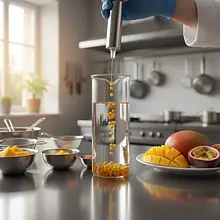
Take the chilled oil out of the freezer. Prepare a dropper tool – it can be a syringe (without a needle), a pipette, an eye dropper, or a small bottle with a thin dispenser. Fill the tool with the warm fruit mixture.

A 10-20 ml syringe works best as it provides the greatest control over the size of the drops. If you don't have any of these tools, you can ultimately use a small teaspoon and very carefully pour the liquid from its tip.
7

Holding the syringe about 5-10 cm above the surface of the cold oil, start slowly pressing the plunger to let the liquid drip into the oil drop by drop. You will see each drop, upon contact with the cold oil, immediately form into a perfect ball and slowly sink to the bottom of the vessel. Work in batches, not letting too many pearls in at once to avoid them sticking together.

The height from which you drop the droplets matters. Too low will result in flat discs, too high will create 'tails'. Experiment to find the perfect height. The pressure applied to the piston controls the size of the pearls.

Draining and rinsing the caviar

8

When all the pearls have settled to the bottom, wait another minute until they fully firm up. Then, using a slotted spoon or a small sieve, gently scoop the caviar out of the oil. Transfer it to a sieve with very fine mesh.

Do not stir the oil vigorously to avoid damaging the delicate pearls. Move the sieve slowly to collect all the caviar from the bottom of the container.
9

To remove excess oil, gently rinse the caviar under a stream of cold running water. A few seconds will suffice. Shake the sieve to drain as much water as possible. The prepared caviar is now shiny, firm, and not greasy.

The stream of water must be very gentle so as not to destroy the pearls. You can also submerge the sieve with the caviar in a bowl of cold water and gently move it.

Storage

10

Transfer the prepared caviar to a clean, small jar or container. If you are not using it right away, you can cover it with a bit of mango juice to prevent it from drying out. Store in the refrigerator. The caviar is ready to use as a spectacular decoration!

Store the caviar in a closed container in the refrigerator for a maximum of 3 days. It tastes and looks best on the day it is prepared. Do not freeze the caviar, as it will lose its unique texture.

Fun Fact

💡

The spherification technique used to create this caviar was popularized in the early 21st century by the famous Spanish chef Ferran Adrià in his legendary restaurant elBulli. It is one of the most well-known examples of molecular cuisine, which uses scientific principles to create new textures and forms in food.

Best for

Tips

🍽️ Serving

Serve caviar as an exquisite decoration on white panna cotta, creamy cheesecake, chocolate mousse, or a scoop of vanilla ice cream. Add a teaspoon to a glass of Prosecco to create a 'bubbles' effect with fruity flavor. It also looks fantastic on morning yogurt with granola, creating a luxurious breakfast.

🥡 Storage

It is best to consume caviar within 24 hours of preparation. It can be stored in an airtight container in the refrigerator for up to 3 days. To prevent it from drying out, you can cover it with a small amount of fruit juice. It is not suitable for freezing.

📸 Ugotowane przez społeczność

Zaloguj się, aby dodać zdjęcie
Dodaj zdjęcie gotowej potrawy

Po zatwierdzeniu przez moderatora otrzymasz 10 punktów doświadczenia.

🍲

Nikt jeszcze nie dodał zdjęcia. Bądź pierwszy!

Comments (0)

Be the first to comment on this recipe!

Add a comment

You might also like

Recipe Categories

Desserts
Desserts in: New Year's Eve

A sweet ending to the New Year's Eve dinner is a must-have that will put everyone in a joyful mood for the new year.

See all recipes in this category
Desserts for Kids
Desserts for Kids in: For Kids

Desserts for kids are sweet treats without guilt - less sugar, more flavor. Banana ice cream without sugar - frozen bananas blended to a creamy consistency. Chocolate mousse with avocado - creamy and healthy. Vanilla pudding with fruit - a childhood classic. Carrot and apple muffins - hidden vege...

See all recipes in this category

Dishes for special occasions are culinary masterpieces for birthdays, anniversaries, and holidays. Grilled beef steak with herb butter - restaurant quality at home. Beef Wellington - beef in puff pastry with duxelles. Roast duck with apples - a holiday tradition in a new edition. Pink salmon with...

See all recipes in this category
Additions
Additions in: Christmas Eve Dinner

Side dishes complement main courses and influence the overall meal experience. In this category, we present recipes for potatoes, grains, rice, dumplings, and salads. Our dishes include classic Polish sides - kopytka, Silesian dumplings, mashed potatoes. You will also find modern alternatives - q...

See all recipes in this category
Reklama