Start by preparing the filling for the dumplings. Wash the potatoes thoroughly, peel them, and cut them into smaller cubes so they cook faster. Place them in a large pot, cover with cold water so that they are completely submerged, and add one flat teaspoon of salt. Cook over medium heat until fully soft, about 20-25 minutes. You can check if they are ready by piercing them with a fork – it should go in without any resistance.
Description
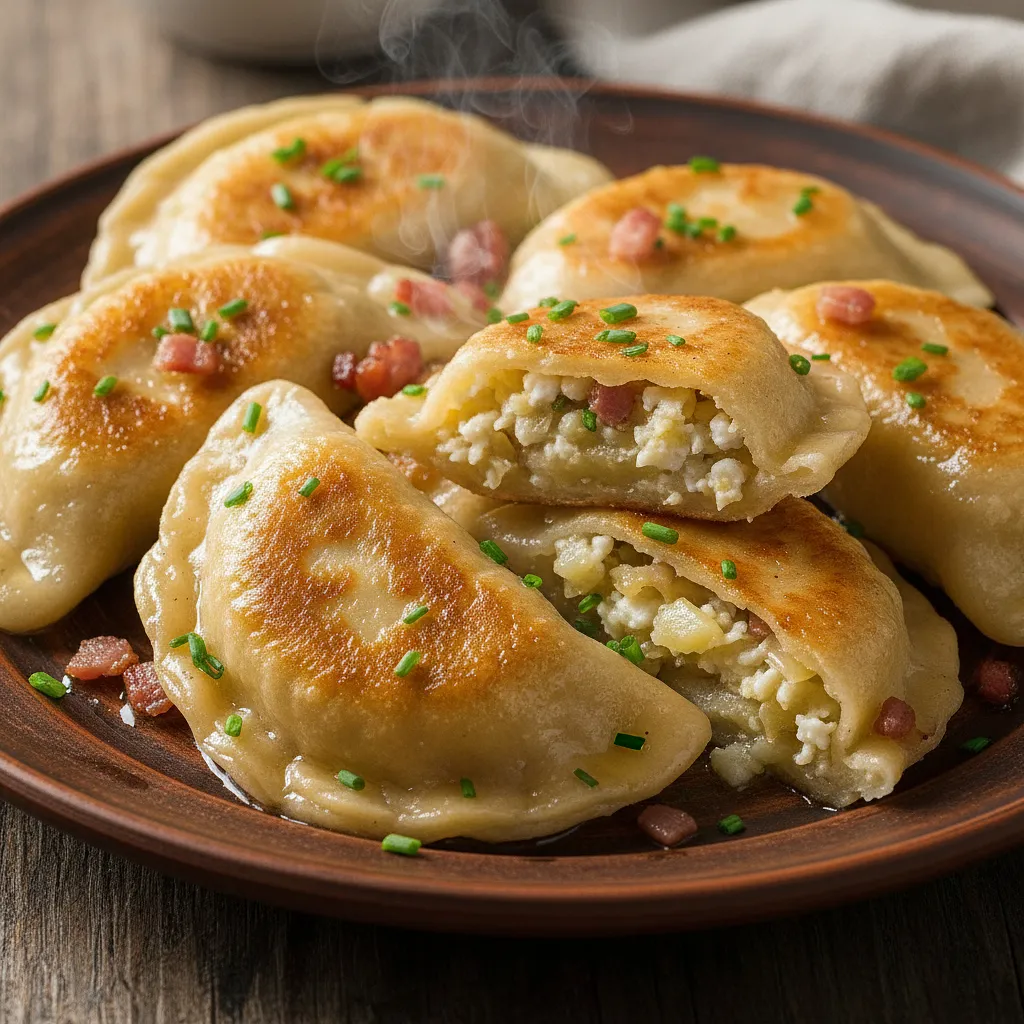
Here’s a recipe that will take you back in time to your grandmother's kitchen. These are not ordinary Russian dumplings. Their secret lies in the filling, which is the heart and soul of this dish. Instead of serving the topping on top, in this recipe, crispy smoked bacon and golden onions are blended directly into the potato-cheese mixture. Each bite is an explosion of flavor – the creamy filling is complemented by the smoky aroma and the sweetness of caramelized onions. The dough, prepared with hot water and butter, is incredibly flexible, thin after cooking, yet sturdy during shaping. This dish is the essence of Polish home cooking – hearty, comforting, and full of love. Perfect for a family dinner that brings everyone together at one table and evokes the warmest memories.
Ingredients Used
Ingredients (10)
- Potatoes 6.7 szt.
- Semi-fat cottage cheese 500 g
- Boczek wędzony surowy 200 g
- Onion 2 szt.
- Mąka pszenna typ 450 lub 500 500 g
- Gorąca woda 250 ml
- Butter 25 g
- 🌿 Przyprawy
- Salt 15 g
- Pieprz czarny świeżo mielony 5 szczypt
- ✨ Opcjonalne
- Dried marjoram 1 łyżeczka
💡 Kliknij na składnik aby oznaczyć jako użyty
Preparation steps
Filling
While the potatoes are cooking, prepare the filling's seasoning. Cut the bacon into very small cubes, about 0.5 cm on each side. Also, peel and finely chop the onions. The finer you chop the ingredients, the more uniform the filling will be.
In a large, cold skillet, place the chopped bacon. Heat over medium heat. The fat will begin to slowly render. Fry the bacon for about 8-10 minutes, stirring occasionally, until it becomes golden and crispy. Then add the chopped onion and fry together with the bacon for another 10-12 minutes, until the onion softens, becomes translucent, and takes on a beautiful golden color. Remove the skillet from the heat and set aside to cool slightly.
Drain the cooked potatoes very thoroughly in a colander and leave for 2 minutes to steam off. Transfer the hot potatoes back to the pot and mash them thoroughly with a potato masher until smooth and lump-free. Crumble the cheese in your hands or mash it with a fork in a separate bowl. Add the crumbled cheese and the entire contents of the pan (bacon, onion, and rendered fat) to the hot potatoes. Season generously with salt (about 2 teaspoons) and freshly ground pepper (about 1 teaspoon). If using, add the marjoram crushed in your hands. Mix everything very vigorously with a large spoon until the ingredients are combined. Taste and adjust seasoning if necessary. The filling should be flavorful and slightly spicy. Set aside to cool completely.
Dough for Dumplings
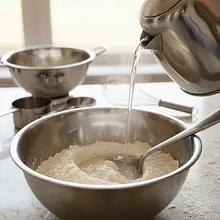
While the filling is cooling, prepare the dough. Sift the flour into a large bowl or onto a work surface to aerate it. Make a well in the center, resembling a volcano crater. Add half a teaspoon of salt to the well. Melt the butter in a small saucepan and pour it into the well as well.
Slowly pour hot water into the bowl with flour in a thin stream, while mixing everything with a fork or spoon. Do this carefully to avoid burns. Mix from the center, gradually incorporating the flour from the edges until a dense, lumpy mass forms. When the dough cools slightly, transfer it to a work surface and start kneading by hand.
Knead the dough for about 10-15 minutes. Base your kneading technique on pushing and folding movements: push the dough away from you with the palm of your hand, then fold it in half and rotate it 90 degrees. Repeat this process. The dough is ready when it becomes smooth, elastic, and no longer sticks to your hands or the work surface. It should be soft like playdough or an earlobe. Shape it into a ball, wrap it in plastic wrap or cover it with a warm bowl, and let it rest for 20-30 minutes.
Shaping and Forming Dumplings
Rested dough divide into 3-4 parts. Leave one part on the countertop, and keep the rest covered to prevent drying out. Lightly dust the countertop with flour. Roll out the dough into a very thin circle, about 2-3 mm thick. Remember to turn the dough while rolling to prevent it from sticking to the countertop.
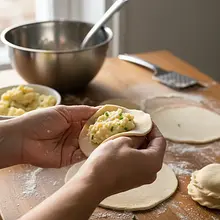
Using a glass with thin edges or a special cutter, cut out circles from the dough with a diameter of about 8 cm. Gather the leftover dough from cutting, knead it again, and set it aside covered - you will use it at the end. Place a heaping teaspoon of cooled filling in the center of each circle.
Now the most important moment: shaping. Fold the circle in half, enclosing the filling inside, creating a crescent shape. Use your fingers to press the edges of the dough very tightly to eliminate air bubbles. Then, to ensure that the dumpling doesn't open, you can press the edges with a fork or create a decorative ruffle. To make it, start at one corner, fold a small piece of the edge inward and press, moving along the entire seam.
Cooking and Serving
In a large, wide pot (minimum 5 liters), bring water to a boil. When it starts to boil, add a generous tablespoon of salt. Reduce the heat so that the water is just gently 'bubbling' and not boiling vigorously. Gently, in batches (about 15-20 pieces at a time), place the dumplings into the water, stirring gently with a wooden spoon to prevent them from sticking to the bottom.
When the dumplings float to the surface, cook them for another 2-3 minutes. The cooking time depends on the thickness of the dough. After this time, carefully remove them from the water using a slotted spoon, allowing the excess water to drain. Transfer them to a large plate or platter. Serve immediately, hot, drizzled with melted butter or your favorite topping.
Fun Fact
The word 'pierogi' is the plural form in Polish – a single piece is called 'pieróg'. This dish most likely arrived in Poland in the 13th century from Kievan Rus, thanks to the Dominican friar Jacek Odrowąż, who is said to have been enchanted by them during his travels.
Best for
Tips
Serve freshly cooked, drizzled with melted butter and topped with golden sautéed onions. Next to it, place a bowl of thick 18% sour cream for dipping. The cooked dumplings can also be pan-fried in butter or lard until golden and crispy on both sides – for many, this is the tastiest version.
Raw dumplings: place them on a tray dusted with flour so they do not touch. Put in the freezer for 1-2 hours. Once they are firm, transfer to ziplock bags. Cook from frozen (drop into boiling water), for an additional 2-3 minutes. Cooked dumplings: store in the refrigerator in a closed container for up to 2 days. Before serving, pan-fry.
📸 Ugotowane przez społeczność
Zaloguj się, aby dodać zdjęcieDodaj zdjęcie gotowej potrawy
Po zatwierdzeniu przez moderatora otrzymasz 10 punktów doświadczenia.
Nikt jeszcze nie dodał zdjęcia. Bądź pierwszy!
Comments (0)
Be the first to comment on this recipe!
Add a comment