Pumpkin Kofta in Creamy Korma Sauce

Pikantne Indian Cuisine Vegetarian Dishes Dishes for Special Occasions 90 min Medium 9 wyświetleń ~33.46 PLN - (0)
Rate:
(0)
Start Cooking

Description

This exquisite vegetarian dish draws inspiration from the rich cuisine of Northern India, specifically from Mughal traditions. Pumpkin Kofta in Korma Sauce is a celebration of autumn flavors in an exotic rendition. At the heart of the dish are delicate, melt-in-your-mouth meatballs (kofta) made from pumpkin purée, Indian paneer cheese, and aromatic spices, which gain a crispy crust and soft interior when fried to a golden brown. They are enveloped in a velvety, creamy, and mild korma sauce, based on ground cashews, yogurt, and a subtle blend of spices such as cardamom, cloves, and saffron. The dish has a beautiful golden-orange color, and its flavor is complex – slightly sweet from the pumpkin and cashews, balanced by mild spiciness and the deep aroma of warm spices. Served with basmati rice and naan bread, it constitutes a wholesome, luxurious meal, perfect for special occasions or chilly evenings.

Ingredients (23)

Servings:
4
  • Hokkaido or butternut squash 400 g
  • Paneer cheese 200 g
  • Chickpea flour (besan) 3.3 łyżki
  • Cashews 100 g
  • Onion 1 szt.
  • Thick natural yogurt 150 g
  • 30% cream 100 ml
  • Fresh ginger 20 g
  • Garlic 3 ząbki
  • Vegetable oil for deep frying 500 ml
  • Ghee or vegetable oil for the sauce 2 łyżki
  • Ground coriander 4 g
  • sugar 5 g
  • 🌿 Przyprawy
  • Green chili pepper 1 szt.
  • Garam masala 6 g
  • Ground turmeric 0.4 łyżeczek
  • ground cumin 0.4 łyżeczek
  • Bay leaf 6.7 szt.
  • Green cardamom 4 szt.
  • Cloves 2 g
  • Salt 10 g
  • ✨ Opcjonalne
  • Fresh cilantro 15 g
  • Saffron 0.1 g
💰 Szacowany koszt dania: ~33.46 PLN (8.36 PLN/porcję)

💡 Kliknij na składnik aby oznaczyć jako użyty

Preparation steps

Preparation of Kofta

1

Start by preparing the pumpkin. Wash it, cut it in half, and remove the seeds with a spoon. If you are using butternut squash, peel it. Hokkaido squash does not need to be peeled. Grate the flesh of the pumpkin on a coarse grater into a large bowl.

Ingredients: Hokkaido or butternut squash
Use a standard kitchen grater (also known as a box grater). Grating on the coarse side will give a better texture than chopping in a food processor.
2

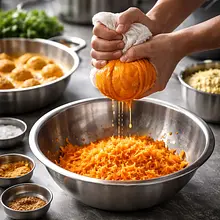
Grated pumpkin contains a lot of water that needs to be removed so that the kofta do not fall apart while frying. Transfer the grated pumpkin to the center of a clean kitchen towel or cheesecloth. Gather the corners of the fabric to create a pouch and squeeze tightly over the sink or a bowl to remove as much juice as possible. You should get about 250-300g of fairly dry pumpkin mass.

Ingredients: Hokkaido or butternut squash
This is an absolutely crucial step! Do not skip it. Too wet a mixture will cause the kofta to need more flour, making them tough and potentially causing them to fall apart in hot oil.
3

In a bowl with the drained pumpkin, add crumbled paneer cheese. You can grate it or simply break it up with your fingers. Add chickpea flour, finely chopped or grated ginger (10g), garlic pressed through a garlic press (2 cloves), finely chopped chili pepper (seedless if you prefer a milder version), 2 teaspoons of garam masala, 1 teaspoon of turmeric, and 1 teaspoon of salt. Optionally, add chopped fresh coriander.

Ingredients: Paneer cheese, Chickpea flour (besan), Fresh ginger, Garlic, Green chili pepper, Garam masala, Ground turmeric, Salt, Fresh cilantro
It is best to grate the ginger and garlic on a fine grater to create a paste - this way, the aroma will be evenly distributed throughout the mixture.
4

Thoroughly mix all the ingredients in a bowl by hand, gently kneading until a uniform, compact mass is formed, from which you can shape balls. The mixture should not be too sticky. If it is, add a little more chickpea flour, but not too much, so that the kofta do not become hard. From the prepared mixture, shape small balls the size of a walnut (about 2.5-3 cm in diameter). You should get about 16-20 balls.

To prevent the dough from sticking to your hands, lightly grease them with oil. Try to make all the balls of similar size - this will ensure they fry evenly.

Frying Kofta

5

In a deep pot or wok, heat the deep frying oil (about 500 ml). The oil should be at a temperature of about 170-180°C. If you don't have a thermometer, drop a small piece of the batter in – if it floats to the surface and starts to sizzle, creating bubbles around it, the oil is ready. If it browns immediately, the temperature is too high.

Ingredients: Vegetable oil for deep frying
Use a heavy-bottomed pot that retains heat well. Do not fill it with oil higher than halfway to avoid overflowing while frying.
6

Carefully place the kofta into the hot oil, in batches of 4-5 pieces. Do not overcrowd the pot, as this will lower the oil temperature and the kofta will absorb fat instead of frying. Fry for 3-4 minutes, gently turning them with a slotted spoon, until they are evenly golden-brown and crispy on the outside.

Be patient and do not flip the koftas too early; let them form a crispy crust first. Use a slotted spoon to place and remove the balls to drain excess oil.
7

Remove the fried kofta with a slotted spoon and place them on a plate lined with paper towels to drain excess fat. Do the same with the remaining batches. Set aside while preparing the sauce.

Draining on a paper towel is important to ensure the kofta are not too greasy and maintain their crispiness.

Preparation of Korma Sauce

8

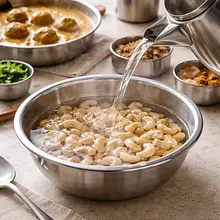
Prepare the cashew paste. Soak the cashews in hot water and let them sit for at least 15-20 minutes to soften. Then drain them (reserve some of the soaking water) and transfer to a blender. Blend until you have a perfectly smooth, creamy paste, adding 1-2 tablespoons of the soaking water if needed to facilitate blending.

Ingredients: Cashews
Use a high-power blender to ensure the paste is really smooth and lump-free. This is the secret to the velvety consistency of korma sauce.
9

In a large skillet or wide pot, heat 2 tablespoons of ghee or oil over medium heat. Add the whole spices: 2 bay leaves, 2 lightly crushed cardamom pods, and 2 cloves. Sauté for about 30 seconds until they release their aroma.

Ingredients: Ghee or vegetable oil for the sauce, Bay leaf, Green cardamom, Cloves
A light crushing of the cardamom pods (e.g., with the flat side of a knife) will help release the seeds and their intense aroma while frying.
10

Add finely chopped onion and sauté, stirring occasionally, for 8-10 minutes until it becomes soft, golden, and sweet. Then add the ginger paste (remaining 10g) and garlic (remaining 1 clove) and sauté for another minute until it starts to smell fragrant.

Ingredients: Onion, Fresh ginger, Garlic
Patient, slow frying of the onion is key to achieving a sweet sauce base. Do not rush this step and do not burn the onion.
11

Reduce the heat and add the ground spices: 2 teaspoons of ground coriander and 1 teaspoon of cumin. Sauté, stirring constantly, for about 30-40 seconds. Be careful not to burn them, as they will become bitter.

Ingredients: Ground coriander, ground cumin
Sautéing ground spices in fat (known as 'blooming') releases their essential oils and deepens the flavor of the entire dish.
12

Add the prepared cashew paste. Mix well with the spices and cook on low heat for 2-3 minutes, stirring constantly, until the paste thickens slightly and starts to separate from the fat.

Ingredients: Cashews
Stir continuously, as the cashew paste tends to stick to the bottom of the pan and burn.
13

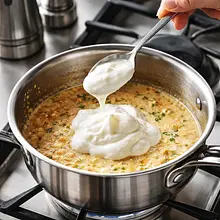
Now the most important moment: adding the yogurt. Reduce the heat to the absolute minimum. In a separate bowl, whisk the yogurt with a fork until smooth. Add the yogurt to the sauce one tablespoon at a time, stirring vigorously after each addition until fully combined. Continue until you have added all the yogurt. This method will prevent the yogurt from curdling.

Ingredients: Thick natural yogurt
Make sure the yogurt is at room temperature. Cold yogurt added to hot sauce will almost certainly curdle. Keep stirring!
14

When the yogurt is fully combined with the sauce, pour in about 250 ml of warm water. Add 1 teaspoon of salt and 1 teaspoon of sugar. Mix thoroughly, bring to a gentle boil, then reduce the heat and cook covered for 10-12 minutes, until the sauce thickens and fat appears on the surface.

Ingredients: Salt, sugar
You can adjust the sauce's thickness by adding water. If it seems too thick, add a little more warm water.

Serving

15

Finally, remove the sauce from the heat. Pour in the 30% cream and add 1 teaspoon of garam masala. If you are using saffron, dissolve it in 2 tablespoons of warm milk or water and also add it to the sauce. Gently mix. Taste the sauce and season with salt if necessary.

Ingredients: 30% cream, Garam masala, Saffron
Add garam masala and cream at the end, without further cooking, to preserve their full aroma and creamy texture.
16

Just before serving, gently transfer the fried kofta to the warm sauce. Allow them to heat for 1-2 minutes, but do not cook them in the sauce to avoid losing their crispiness. Transfer the dish to a bowl, garnish with chopped fresh coriander, and serve immediately with hot basmati rice or naan bread.

Ingredients: Fresh cilantro
If you are preparing the dish in advance, store the sauce and kofta separately. Heat the sauce, and refresh the kofta in the oven or air fryer, then combine them just before serving.

Fun Fact

💡

The word 'Kofta' comes from the Persian language from 'kūfta', which means 'ground' or 'beaten'. This technique was brought to India by the Mughals. Although kofta were originally a meat dish, Indian vegetarian cuisine adapted this form, creating countless variations with vegetables, paneer cheese, and lentils, such as the famous 'malai kofta' or these seasonal pumpkin ones.

Best for

Tips

🍽️ Serving

Serve the dish immediately after adding the koft to the sauce to maintain their crispiness. It pairs perfectly with fluffy basmati rice, which will absorb the aromatic sauce, or with warm naan or roti for dipping. A delicate sprinkle of chopped fresh coriander or almond flakes will add freshness and texture. You can also drizzle a bit of cream for garnish.

🥡 Storage

Kofta and sauce are best stored separately in airtight containers in the refrigerator for up to 2 days. The sauce can be reheated over low heat, stirring. Kofta is best reheated in an oven preheated to 180°C for 5-7 minutes or in an air fryer to restore their crispiness. Combine the ingredients just before serving.

📸 Ugotowane przez społeczność

Zaloguj się, aby dodać zdjęcie
Dodaj zdjęcie gotowej potrawy

Po zatwierdzeniu przez moderatora otrzymasz 10 punktów doświadczenia.

🍲

Nikt jeszcze nie dodał zdjęcia. Bądź pierwszy!

Comments (0)

Be the first to comment on this recipe!

Add a comment

You might also like

Recipe Categories

Indian cuisine is a fascinating journey through a continent of spices - from mild to fiery. Curry in a hundred variations: tikka masala, butter chicken, korma, vindaloo, and madras. Biryani, pulao, and dal - rice and lentil dishes full of aroma. Naan, chapati, and paratha - Indian breads baked in...

See all recipes in this category

Vegetarian cuisine is a wealth of flavors without meat - healthy, colorful, and filling. Plant-based proteins: lentils, chickpeas, beans, peas, and soy take center stage. Cheeses and dairy: feta, halloumi, ricotta, and mascarpone in main dishes. Eggs in various forms: omelets, frittata, shakshuka...

See all recipes in this category

Dishes for special occasions are culinary masterpieces for birthdays, anniversaries, and holidays. Grilled beef steak with herb butter - restaurant quality at home. Beef Wellington - beef in puff pastry with duxelles. Roast duck with apples - a holiday tradition in a new edition. Pink salmon with...

See all recipes in this category

Lunches are the main meal of the day - filling, balanced, and full of flavor. Traditional two-course lunches: soup and a main dish in Polish tradition. Pork chop with potatoes and cabbage - a classic of Polish lunches. Dumplings with meat, cheese, and fruit - hand-formed delicacies. Beef goulash,...

See all recipes in this category
Reklama