In a large bowl, combine the dry ingredients for the dough. Add 200g of all-purpose flour, 30g of powdered sugar, 30g of ground almonds, and a pinch of salt. Use a whisk or fork to mix everything thoroughly and aerate it. The goal is to ensure the ingredients are evenly distributed before adding the fat.
Description
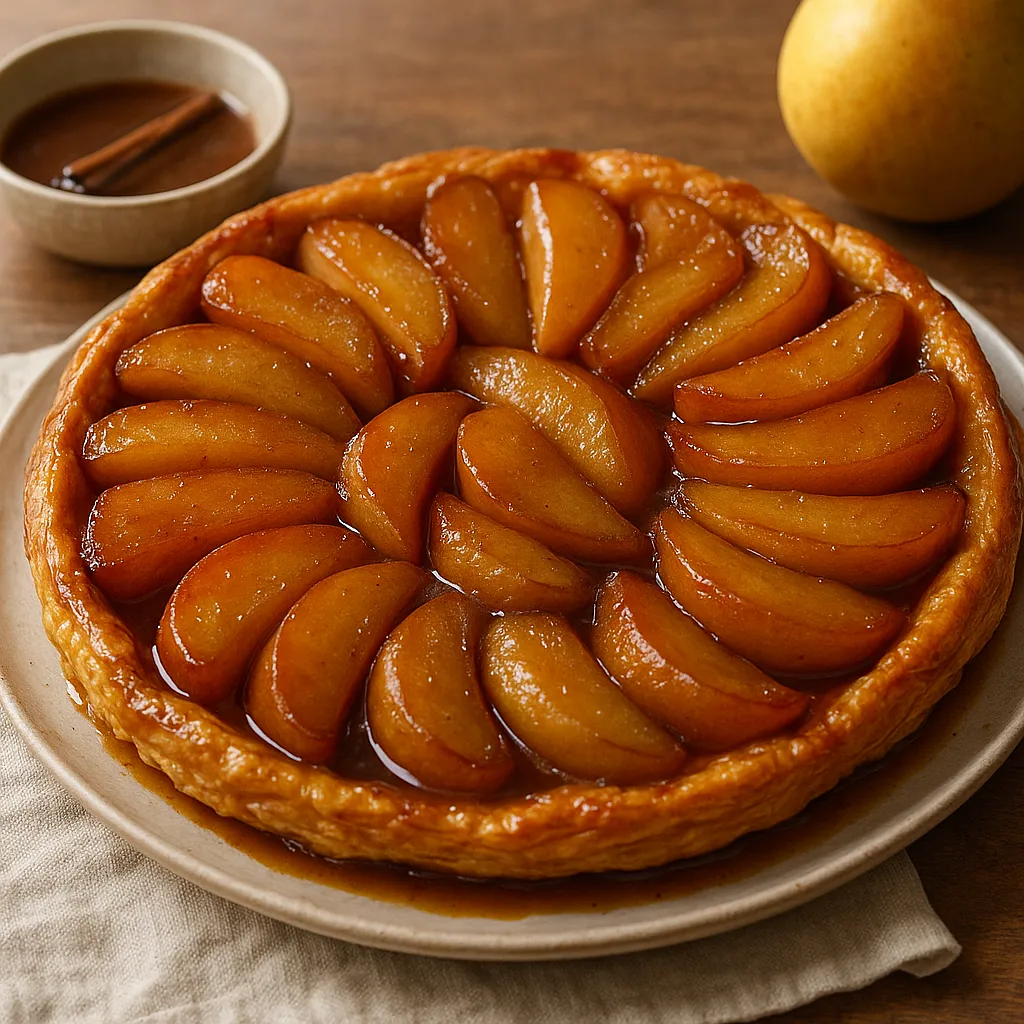
This is a unique variation on the French classic – Tarte Tatin. Instead of the traditionally used apples, this recipe combines their tartness with the sweetness and delicate, grainy texture of pears. The secret to the depth of flavor is the caramel, which is not just any caramel. It has been enriched with aromatic star anise and a pinch of cardamom, giving the whole dish a warm, spicy, and slightly exotic character. The entire tart is covered with homemade, buttery shortcrust pastry with the addition of ground almonds, which becomes incredibly crunchy and nutty after baking. The tart, baked upside down, presents beautifully when turned over – the fruits bathed in a glossy, amber sauce create an appetizing mosaic. Serve it warm with a dollop of cool crème fraîche or Greek yogurt, which perfectly balances the sweetness of the caramel.
Ingredients (14)
- Mąka pszenna tortowa (typ 450) 200 g
- Butter 150 g
- Cukier drobny 150 g
- Powdered sugar 30 g
- Apples (hard and sour) 3 szt.
- Pears (firm) 2 szt.
- Ground almonds 30 g
- Egg yolk 1.1 szt.
- Cold water 15 ml
- 🌿 Przyprawy
- Salt 0.0 szczypt
- Star anise 0.4 szt.
- ✨ Opcjonalne
- Ground cardamom 1 g
- Crème fraîche 100 g
- Almond flakes 15 g
💡 Kliknij na składnik aby oznaczyć jako użyty
Preparation steps
Almond Shortcrust Pastry
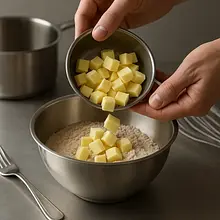
Add 100g of very cold butter, cut into small cubes (about 1x1 cm), to the bowl with the dry ingredients. Now for the most important part: using only your fingertips, quickly rub the butter into the flour until the mixture resembles wet sand or crumbs. Try to work quickly so that the butter doesn't warm up from the heat of your hands.
Make a well in the center of the mixture. Crack one egg yolk into it and pour in one tablespoon (15 ml) of ice-cold water. Using a fork or knife, gently start to incorporate the dry ingredients into the center until they begin to combine. Then, very briefly knead the dough by hand, just until a relatively uniform ball forms. Do not knead it for long!
Shape the dough into a ball and gently flatten it to form a disk about 2 cm thick. Wrap it tightly in plastic wrap and place it in the refrigerator for at least 30 minutes, preferably for an hour. Chilling is essential for the butter to firm up again and for the gluten in the dough to 'rest'.
Preparation of fruits and caramel
While the dough is chilling, prepare the fruit. Wash the apples and pears, peel them using a vegetable peeler. Then cut each into four pieces (quarters) and use a small knife to remove the cores. Try to make the quarters of equal size.
Prepare a heavy, ovenproof skillet with a diameter of 24-26 cm (preferably cast iron or steel with a thick bottom). Evenly sprinkle 150g of fine sugar on it. Place it on a medium heat burner and patiently wait. Do not stir! Watch as the sugar begins to melt from the edges. You can only gently move the entire skillet to allow the liquid sugar to cover the dry crystals. Cook until all the sugar has dissolved and achieves a beautiful amber color.
When the caramel reaches the desired color, immediately remove the pan from the heat. Be careful, it is extremely hot! Carefully add 50g of diced butter. The caramel will start to bubble and splatter violently - this is a normal reaction. Stir vigorously with a wooden spoon until the butter completely melts and combines with the caramel into a smooth sauce. Toss in 2 star anise and optionally a pinch of cardamom.
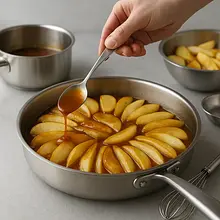
In the bottom of the pan, in hot caramel sauce, start arranging the prepared quarters of apples and pears. Place them tightly, one next to the other, alternating to create a pattern (e.g. concentric circles). Remember that this side will be the top of the tart. Press the fruits into the caramel, don't be afraid to pack them in, as they will slightly reduce in volume during cooking.
Assembling and baking the tart
Preheat the oven to 190°C (fan) or 200°C (top-bottom). Take the chilled dough out of the fridge. On a lightly floured surface or a piece of baking paper, roll out the dough into a round shape about 2-3 cm larger in diameter than your pan and about 3-4 mm thick.
Carefully transfer the rolled-out dough and cover the fruit in the pan with it. You can loosely roll the dough onto a rolling pin to make it easier to move. Once the dough is in place, using a spoon or your fingers, tuck the edges inward, between the fruit and the sides of the pan. The edges of the dough should 'wrap' around the fruit.
Take a fork and poke the surface of the dough in several places. These small holes will allow steam to escape during baking, ensuring that the dough doesn't puff up and bakes crispy.
Place the pan in the preheated oven. Bake for about 30-35 minutes. The tart is ready when the crust on top has a deep golden-brown color and the caramel sauce is bubbling enticingly at the edges of the pan.
Final: Flipping and Serving
Carefully remove the pan from the oven and place it on a board or rack. Let the tart 'rest' for exactly 5-10 minutes. This is a very important step - if you turn it out immediately, the hot caramel will be too runny. If you wait too long, the caramel will set and stick the fruit to the bottom of the pan.
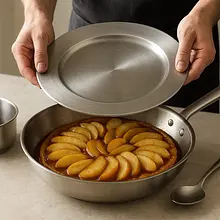
Prepare a large plate or platter with a diameter larger than the skillet. Cover the skillet with it. Now comes the hardest part: grab the plate and the hot handles of the skillet (using oven mitts!). With a decisive, quick motion, flip everything upside down. Place the plate on the countertop and slowly lift the skillet. The tart should smoothly fall onto the plate, revealing the caramelized fruits.
Serve the tart warm, when the caramel is still liquid and the crust is crispy. Cut it into portions with a sharp knife. Next to each piece, add a generous dollop of crème fraîche or thick Greek yogurt. If using, sprinkle everything with toasted almond flakes for extra crunch.
Fun Fact
Legend has it that Tarte Tatin was created by mistake in the late 19th century. Sisters Stéphanie and Caroline Tatin, who ran a hotel in Lamotte-Beuvron, France, one day while preparing an apple pie, forgot to put the pastry at the bottom of the pan. In a hurry, Stéphanie tossed apples with butter and sugar into a skillet, covered them with pastry, and put it in the oven. To save the dessert, she served it to guests upside down. It turned out to be a hit and became the signature dish of the Tatin hotel.
Best for
Tips
Tarte Tatin tastes best served warm, about 15-20 minutes after taking it out of the oven. It is best cut with a sharp, serrated knife. An essential addition is something to balance the sweetness – vanilla ice cream, unsweetened whipped cream, or preferably thick, sour crème fraîche or Greek yogurt. Sprinkling with toasted almonds or pecans will add wonderful texture.
The tart can be stored at room temperature for up to 24 hours, covered with a dome. In the fridge, it will last 2-3 days, but the crust will lose its crispness. To reheat it, it's best to place a piece in an oven preheated to 160°C for 5-10 minutes. This will restore the crispness of the crust, and the caramel will become liquid again. Reheating in the microwave is not recommended, as it will make the crust soggy.
📸 Ugotowane przez społeczność
Zaloguj się, aby dodać zdjęcieDodaj zdjęcie gotowej potrawy
Po zatwierdzeniu przez moderatora otrzymasz 10 punktów doświadczenia.
Nikt jeszcze nie dodał zdjęcia. Bądź pierwszy!
Comments (0)
Be the first to comment on this recipe!
Add a comment