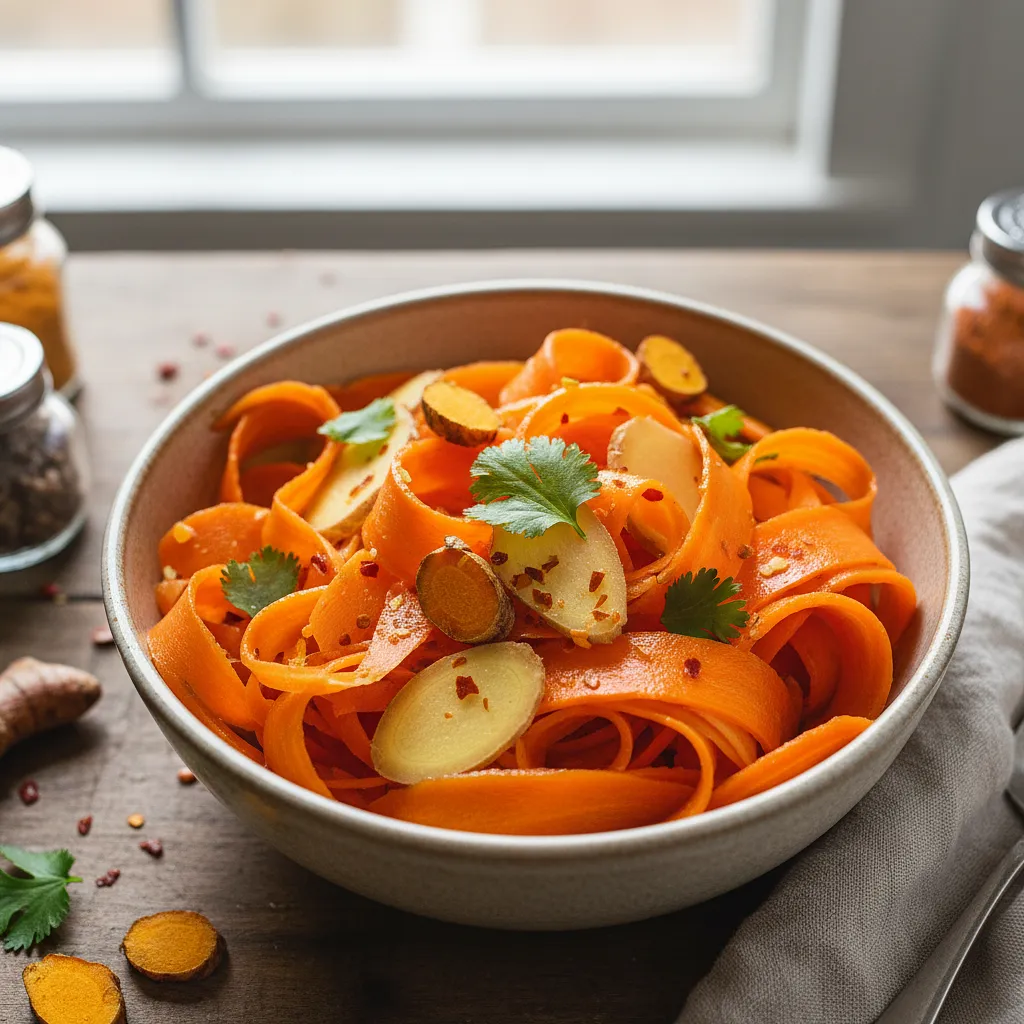
Fermented Carrot and Ginger with Turmeric and Cayenne Pepper

Pikantne Appetizers Snacks Vegan dishes 45 min Easy 5 wyświetleń ~24.24 PLN - (0)
Rate:
(0)
Start Cooking

Description

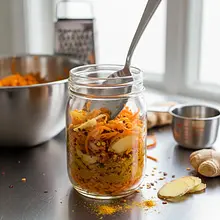
Discover the world of homemade fermentation with this simple yet incredibly aromatic recipe for fermented carrots. This is not just any pickle – it’s a true explosion of flavors and health that will enliven any dish. The combination of the natural sweetness of carrots with the sharp, warming ginger, earthy notes of turmeric, and fiery kick of cayenne pepper creates a snack with a complex, multi-dimensional flavor profile. Visually, it presents spectacularly with its intense orange color enhanced by the gold of turmeric. The process of lacto-fermentation not only preserves the vegetables but also enriches them with valuable probiotics that support gut health. This pickle is a fantastic addition to main dishes, salads, sandwiches, and also serves as a standalone, crunchy, and refreshing snack. It’s the perfect way to preserve summer flavors for longer and introduce natural, unpasteurized products full of vitamins and minerals into your diet.

Ingredients (9)

Servings:
8
  • Carrot 12.5 szt.
  • Fresh ginger 50 g
  • Garlic 4 ząbki
  • Filtered water 500 ml
  • 🌿 Przyprawy
  • Uniodized rock salt 2 łyżki
  • Ground turmeric 1 łyżeczka
  • Cayenne pepper 4 szczypty
  • ✨ Opcjonalne
  • Bay leaf 6.7 szt.
  • Mustard seeds 1 łyżeczka
💰 Szacowany koszt dania: ~24.24 PLN (3.03 PLN/porcję)

💡 Kliknij na składnik aby oznaczyć jako użyty

Preparation steps

Preparation of ingredients

1

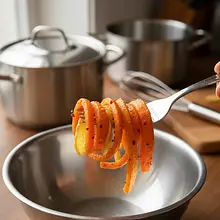
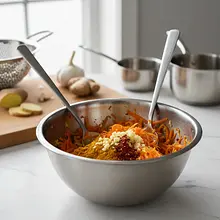
Start by preparing the vegetables. Thoroughly wash the carrots under running water, using a vegetable brush to remove any dirt. Then peel them with a vegetable peeler. Cut off the ends. You can grate the carrots on a coarse grater, cut them into thin strips (julienne) with a sharp knife or mandoline, or use a food processor with the appropriate grating disc. The goal is to achieve thin shreds or strips that will easily release juice.

Ingredients: Carrot
The most important thing is cleanliness! Make sure that the cutting board, knife, grater, and bowl are perfectly clean. Using a food processor will significantly speed up the process when working with a larger amount of carrots. If you are cutting by hand, try to ensure that the sticks are of similar thickness, which will ensure even pickling.
2

Prepare the aromatic additions. Peel the ginger root by scraping off the skin with a teaspoon or a peeler. Also peel the garlic cloves. Grate both the ginger and garlic on a fine grater or press them through a garlic press. We want to achieve almost a paste that will evenly distribute throughout the carrot mixture.

Ingredients: Fresh ginger, Garlic
Scraping ginger with a teaspoon is very effective and allows for minimal loss of flesh. If you don't have a fine grater, you can finely chop the ginger and garlic with a knife.
3

In a large, clean bowl, place the grated carrot. Add the grated ginger, garlic, turmeric, and cayenne pepper. If you are using optional ingredients, add the mustard seeds now. Put on clean gloves (turmeric stains heavily!) and mix everything thoroughly with your hands, while kneading and massaging the carrot for about 5-7 minutes. The goal is for the carrot to start releasing juice. You will notice that its volume decreases slightly, and liquid will appear at the bottom of the bowl.

Ingredients: Carrot, Fresh ginger, Garlic, Ground turmeric, Cayenne pepper, Mustard seeds
This is a key step! Massaging the carrot 'opens' its cell structure, which facilitates fermentation and makes the pickle juicier. Don't skip this stage. Use a large bowl to prevent anything from spilling over.

Preparing the brine

4

Prepare the brine. In a separate jug or bowl, pour in 500 ml of filtered (or boiled and cooled) water. Add 30 grams of non-iodized rock salt. Stir vigorously with a spoon until the salt is completely dissolved. There should be no visible crystals at the bottom of the container. The finished brine should be clear.

Ingredients: Uniodized rock salt, Filtered water
The use of chlorinated water or iodized salt can kill good bacteria and ruin the entire fermentation process. Make sure the salt is completely dissolved before pouring it over the vegetables.

Layering in the jar

5

Prepare a large, sterilized jar (with a capacity of about 1.5 liters). Pack the carrot mixture into the jar in batches, pressing it down firmly and tamping it down with a clean fist, wooden stick, or pestle after each batch. The goal is to remove as many air bubbles as possible and to tightly pack the vegetables. If you are using bay leaves, place them between the layers of carrots.

Ingredients: Bay leaf
The jar must be sterilized clean! You can scald it with boiling water or wash it in the dishwasher at a high temperature. Properly packing the vegetables is key to successful anaerobic fermentation.
6

Once all the carrots are in the jar, pour in the brine you prepared earlier. Pour slowly, allowing the liquid to fill all the spaces. There should be enough brine to completely cover the vegetables. The liquid level should be about 2-3 cm above the level of the carrots. Leave about 3-4 cm of headspace at the top of the jar.

All vegetables MUST be submerged in brine. Any piece sticking out above the surface will mold. If there is not enough carrot juice and brine, make a little more brine in the ratio of 1 tablespoon of salt to 0.5 liters of water.
7

To keep the carrot submerged in the brine, use a weight. This can be a special glass or ceramic fermentation weight, a small plate, a boiled stone, or even a cabbage or horseradish leaf rolled up and pressed on top in home conditions. It is important that the weight is clean and fully submerged.

The most important rule of pickling: whatever is under the water is safe, whatever is above the water is at risk. An improvised weight made from a small jar filled with water that fits into the opening of a large jar will also work great.

Fermentation

8

Screw the jar on, but not too tightly – the fermentation gases need to escape. You can use a special lid with a fermentation tube or simply loosen a standard lid slightly. Place the jar on a plate or in a bowl (in case the brine overflows) in a dark place at room temperature (ideally 18-22°C).

Do not screw the lid on tightly! Carbon dioxide will be produced in the jar, which needs to escape. A too tight seal risks even breaking the jar.
9

Leave the carrot to ferment for 5 to 14 days. After just 1-2 days, you should notice bubbles rising in the jar – this is a sign that fermentation has started. If you are using a regular lid, gently unscrew it once a day to release excess gases ('de-gas'), and then screw it back on. The brine may become cloudy, which is completely normal.

The length of fermentation depends on the temperature and your taste preferences. The warmer it is, the faster it ferments. The longer you ferment, the sourer the pickles will be.
10

After about 5 days, start tasting the fermented vegetables. Using a clean fork, take a small amount and check the flavor. If it is pleasantly sour, crunchy, and has a complex taste, it is ready. If you prefer a more intense flavor, leave it for a few more days, tasting daily. Once it reaches the desired level of fermentation, tightly seal the jar and move it to the refrigerator. The low temperature will stop the fermentation process.

Each attempt must be made with clean utensils to avoid introducing unwanted bacteria into the jar. The finished fermented product can be stored in the refrigerator for several months.

Fun Fact

💡

Vegetable fermentation is one of the oldest methods of food preservation, known for thousands of years. The process of lacto-fermentation not only extends the shelf life of vegetables but also increases the bioavailability of certain vitamins (e.g., B group and K2) and creates natural probiotics that are essential for gut microbiome health.

Best for

Tips

🍽️ Serving

Serve as a crunchy addition to sandwiches, burgers, or tacos to add acidity and spiciness. Mix with natural yogurt and herbs to create a unique dip. Use as a colorful and healthy appetizer on a cheese and cold cuts board. You can also add a bit to cream soup to enhance its flavor.

🥡 Storage

Store the finished pickles in the refrigerator, in a tightly sealed jar. It is important that the vegetables remain submerged in the brine at all times. When stored properly, they will retain their freshness and flavor for at least 3-4 months, and often even longer. Over time, their taste will become deeper and more complex.

📸 Ugotowane przez społeczność

Zaloguj się, aby dodać zdjęcie
Dodaj zdjęcie gotowej potrawy

Po zatwierdzeniu przez moderatora otrzymasz 10 punktów doświadczenia.

🍲

Nikt jeszcze nie dodał zdjęcia. Bądź pierwszy!

Comments (0)

Be the first to comment on this recipe!

Add a comment

You might also like

Recipe Categories

Appetizers
Appetizers in: Christmas Eve Dinner

Appetizers open the meal and prepare the palate for the following dishes. In this category, we present elegant and tasty appetizers for every occasion. Our recipes include carpaccio, tartare, bruschetta, antipasti, and skewers. You will find both cold and warm appetizers here. We pay special atte...

See all recipes in this category
Snacks
Snacks in: New Year's Eve

Snacks are the perfect way to make the wait for midnight more enjoyable; they should be small but impressive.

See all recipes in this category

Vegan cuisine features delicious dishes without animal products - healthy, ethical, and environmentally friendly. Plant-based protein: tofu, tempeh, soy, lentils, chickpeas, and beans take center stage. Vegan dairy substitutes: plant milks, cashew cheese, and vegan yogurts. Recipes for vegan burg...

See all recipes in this category

Vegetarian cuisine is a wealth of flavors without meat - healthy, colorful, and filling. Plant-based proteins: lentils, chickpeas, beans, peas, and soy take center stage. Cheeses and dairy: feta, halloumi, ricotta, and mascarpone in main dishes. Eggs in various forms: omelets, frittata, shakshuka...

See all recipes in this category
Additions
Additions in: Christmas Eve Dinner

Side dishes complement main courses and influence the overall meal experience. In this category, we present recipes for potatoes, grains, rice, dumplings, and salads. Our dishes include classic Polish sides - kopytka, Silesian dumplings, mashed potatoes. You will also find modern alternatives - q...

See all recipes in this category

Gluten-free cuisine is the answer to the needs of people with celiac disease and gluten intolerance. Our recipes use flours: rice, corn, buckwheat, almond, and coconut. Gluten-free bread that tastes like traditional - breads, rolls, baguettes, and focaccias. Pasta made from rice, buckwheat, and c...

See all recipes in this category
Reklama