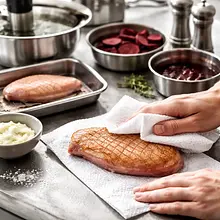
Remove the duck breasts from the refrigerator 30 minutes before cooking to bring them to room temperature — this will ensure even cooking. Clean the pieces of any remaining feathers and pat dry with a paper towel. Using a sharp knife, make delicate crosshatch cuts in the skin (do not cut into the meat) at a 45° angle, which will help render the fat and achieve a crispy skin.
Description
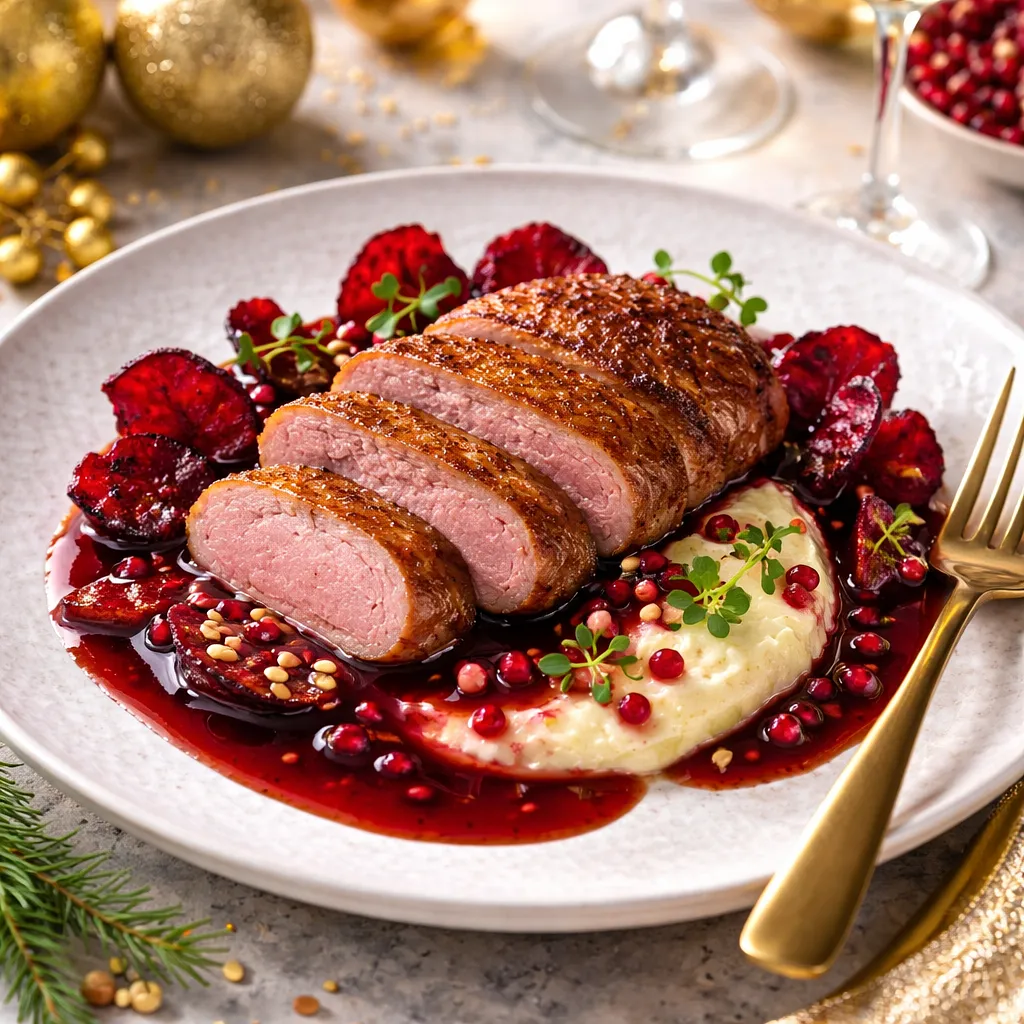
An elegant, modern main dish perfect for New Year's Eve and other special occasions. Juicy duck breast prepared using the sous-vide method for the perfect texture, quickly seared for a crispy skin; served on a smooth, creamy celery puree, with decorative beet chips and a bold red wine sauce with pomegranate juice. The contrast of colors (dark, shiny duck; white puree; red chips and pomegranate seeds) and the balance of sweetness and acidity create a stunning flavor and visual composition that will delight guests. The dish combines modern techniques (sous-vide) with classic elements of French cuisine, while providing simple step-by-step instructions so that even beginners can make it.
Ingredients (16)
- Duck breast 4 szt.
- Celeriac 600 g
- Butter 60 g
- Milk 120 ml
- Beetroot 400 g
- Rapeseed oil 30 g
- Red wine 200 ml
- Chicken broth 250 ml
- Honey 30 ml
- Pomegranate juice 100 ml
- Fresh thyme 0.1 pęczków
- 🌿 Przyprawy
- Salt 0.1 szczypt
- Black pepper 4 szczypty
- ✨ Opcjonalne
- Pomegranate - seeds (arils) 80 g
- Roasted hazelnuts 40 g
- Balsamic vinegar (reduction) - optional 30 g
💡 Kliknij na składnik aby oznaczyć jako użyty
Preparation steps
Meat preparation
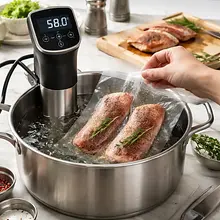
Season the breasts on both sides with salt (about 0.5–1 g per side depending on size) and freshly ground pepper. Place a few sprigs of thyme on the skin and vacuum pack each breast separately in a sous-vide bag. If you don't have vacuum bags, use a thick resealable cooking bag using the water displacement method.
Set the sous-vide device to 58°C for medium-cooked chicken breasts. Place the packaged breasts in the water bath and cook for 1 hour to 1 hour 15 minutes. After cooking, remove the bag from the bath and quickly cool it in ice water for 10 minutes if you plan to speed up the process before searing. The meat at 58°C should have a pink center when reheated.
Alternative to sous-vide: preheat the oven to 160°C. Heat a dry skillet (without oil) over medium heat, place the breasts skin-side down and fry for 6–8 minutes until the fat renders and the skin is golden and crispy. Flip and fry for 2 minutes on the meat side, then transfer the skillet to the oven for 8–12 minutes (depending on thickness) until the internal temperature reaches 58–60°C. After removing, let it rest for 5–8 minutes before slicing.
Puree
Peel the celery and cut it into even cubes of about 2–3 cm. Place it in a pot, cover with cold water so that it covers the vegetables, and add 1 teaspoon of salt (about 2 g). Bring to a boil over medium heat, then reduce the heat and cook for 20–25 minutes until the celery is tender — you can check this with a fork: the fork should go in smoothly without resistance.
Drain the cooked celery, reserving a small amount of the cooking water (~50 ml) to adjust the consistency. Transfer the celery to an immersion blender or food processor, add the butter, and gradually pour in the warm milk, blending until a smooth, creamy puree forms. If it is too thick, add a little of the reserved cooking water. Season to taste with salt and a pinch of pepper.
Beetroot Chips
Wash and peel the beets. Use a mandoline or a sharp knife to slice the beets into very thin slices (about 1–2 mm). Pat the slices dry with a paper towel to remove moisture (this will prevent splattering during frying and ensure crispiness).
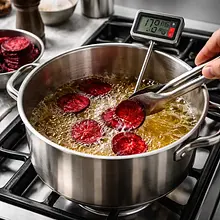
Heat oil in a wide pot or deep fryer to 170–175°C. Add a few slices of beet at a time (do not overcrowd the pot), and fry for 1.5–3 minutes until the slices become firm and slightly brown at the edges. Remove with a slotted spoon onto a paper towel and drain. Lightly salt immediately.
Sauce
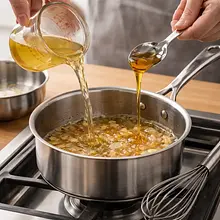
In a medium saucepan over medium heat, combine red wine (200 ml) and pomegranate juice (100 ml). Bring to a gentle boil and simmer for 6–8 minutes, until the volume is reduced by about 30% and the smell of alcohol has dissipated.
Add warm chicken broth (250 ml) and honey (30 g) to the pot. Reduce the heat and cook for 8–10 minutes until the sauce thickens slightly. Taste and season with salt and pepper if needed. Finally, blend the sauce with an immersion blender for a few seconds for a smooth texture and add 10 g of butter, stirring until it melts for shine.
Finishing the meat
If you used sous-vide and the meat was chilled, thoroughly dry the breasts with a paper towel. Heat a cast iron or steel skillet over high heat, add a minimal amount of oil (or 10 g of butter) and place the breasts skin-side down. Sear for 1–2 minutes until the skin becomes very crispy and golden. Flip for 15–30 seconds only on the meat side to refresh the flavor and temperature.
Assembly and decoration
On a warm plate, place 2–3 tablespoons of celery puree as a base. Cut the duck breasts diagonally into slices about 1 cm thick (cutting on the diagonal for a nice presentation). Arrange the slices in a fan shape on the puree. Drizzle 2–3 tablespoons of warm sauce around the meat and on the puree. Garnish with a few beet chips, sprinkle with pomegranate seeds (optional) and finely chopped toasted hazelnuts (optional). Gently drizzle with balsamic vinegar reduction (optional) for shine and additional acidity.
Final tips
Check the temperature of the dish: the internal temperature of the duck breast after searing should be around 58–62°C (for medium). If you are serving family or people who prefer well-done meat, increase the sous-vide to 64–66°C or extend the roasting in the oven as an alternative.
Fun Fact
Duck has been a festive and celebratory meat for centuries in European kitchens; modern methods like sous-vide now allow for achieving classic flavor with precise texture control.
Best for
Tips
Serve the plates hot — warm them up in the oven (about 80°C for 5–7 minutes). Place the puree first, then arrange the duck slices cut on the diagonal on top of the puree. For contrast, add a fresh green salad with balsamic vinegar and arugula. Drinks: red, fruity wine or a stronger cider.
Store meat, puree, and chips separately in the refrigerator for up to 2 days. Chips will lose their crunch—reheat in the oven at 160°C for 5–8 minutes to refresh. Gently reheat the meat in a sous-vide bath at 50–52°C for 20–30 minutes or in the oven at 120°C until it reaches 50–52°C internally. The sauce can be stored for up to 3 days in an airtight container and warmed over low heat.
📸 Ugotowane przez społeczność
Zaloguj się, aby dodać zdjęcieDodaj zdjęcie gotowej potrawy
Po zatwierdzeniu przez moderatora otrzymasz 10 punktów doświadczenia.
Nikt jeszcze nie dodał zdjęcia. Bądź pierwszy!
Comments (0)
Be the first to comment on this recipe!
Add a comment