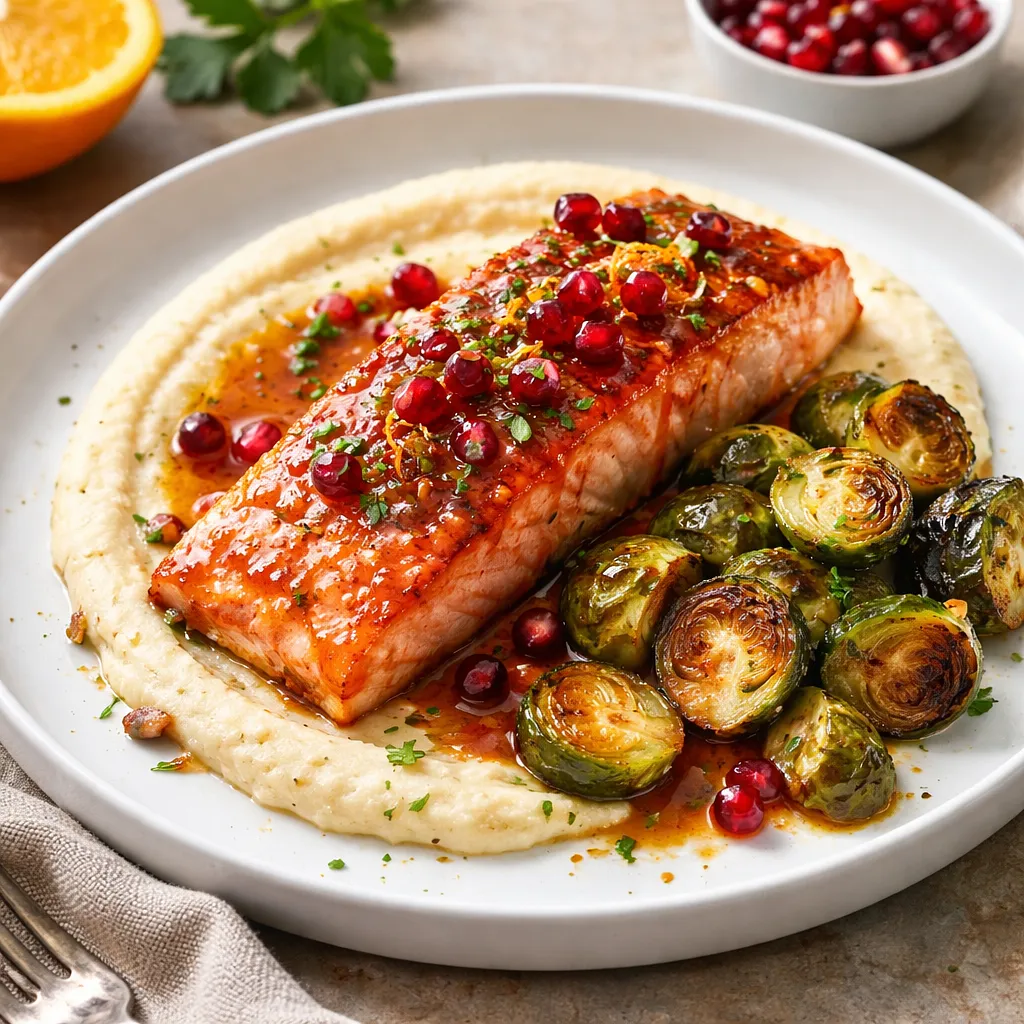
Quick Salmon with Orange-Pomegranate Glaze, Celery Puree, and Caramelized Brussels Sprouts

Pikantne Main dishes European cuisine 35 min Easy 16 wyświetleń ~64.81 PLN - (0)
Rate:
(0)
Start Cooking

Description

A seasonal, impressive main dish combining delicate, quickly fried salmon with a glossy glaze made from fresh orange and pomegranate, along with creamy celeriac puree. The dish is inspired by contemporary cuisine - simplicity and quick techniques allow for a refined effect. A contrast of flavors: the sweetness of the honey-orange glaze, the refreshing tartness of pomegranate and balsamic, and the slightly nutty celeriac. Serve with young potatoes or a light arugula salad; it is perfect for a dinner with guests or a festive winter lunch.

Ingredients (16)

Servings:
4
  • Salmon fillet 600 g
  • Celeriac 600 g
  • Butter 30 g
  • Milk 60 ml
  • Olive oil 30 ml
  • Orange 0.8 szt.
  • Pomegranate (seeds) 100 g
  • Honey 20 ml
  • Dijon mustard 10 g
  • Garlic 2 ząbki
  • Brussels sprouts 400 g
  • Balsamic vinegar 15 ml
  • 🌿 Przyprawy
  • Salt 0.2 szczypt
  • Black pepper 4 szczypty
  • ✨ Opcjonalne
  • Parsley 0.5 pęczek
  • Chili flakes (optional) 2 szczypty
💰 Szacowany koszt dania: ~64.81 PLN (16.20 PLN/porcję)

💡 Kliknij na składnik aby oznaczyć jako użyty

Preparation steps

Preparation

1

Take the salmon out of the fridge about 10 minutes before frying, so the meat is not cold (for faster and more even frying). Pat the fillets dry with a paper towel: place the towel on top, press down, and repeat until the surface is dry.

Ingredients: Salmon fillet
Use paper towels and a flat board. A wet fillet won't achieve a nice crust and will splatter in the pan.


Celeriac puree

2

Peel the celeriac: cut off the ends, and peel with a wide knife until you reach the flesh. Cut into cubes about 2-3 cm on each side, so they cook evenly. Place in a pot, cover with cold water (it should cover the celeriac) and add 3 g of salt. Bring to a boil over high heat, then reduce the heat and cook for 15-18 minutes, until a fork easily goes into the pieces.

Ingredients: Celeriac, Salt
Use a heavy pot with a lid. Check the softness with a fork: if the fork goes in easily, the celery is ready.
6

Drain the cooked celery, reserving some of the cooking water (about 2-3 tablespoons). Add 30 g of butter and 60 ml of milk to the hot celery, then mash with a potato masher or blend with a hand mixer until smooth. If the mixture is too thick, add 1-2 tablespoons of the cooking water. Season with salt and freshly ground pepper to taste. The puree should be smooth, creamy, and slightly fluffy.

Ingredients: Celeriac, Butter, Milk, Salt, Black pepper
If you are using an immersion blender, work briefly to avoid making a sticky mass. Adjust the consistency gradually by adding milk or water.

Caramelized Brussels Sprouts

3

Prepare the Brussels sprouts: trim the tough ends and cut each sprout in half. Heat a large skillet (preferably 26-28 cm) over medium-high heat, pour in 15 g of oil. When the oil is hot (slightly shimmering), place the Brussels sprouts cut side down. Sauté without stirring for 5-7 minutes, until the bottoms start to brown significantly. Add the crushed garlic (10 g) and sauté for 30 seconds, then pour in 15 g of balsamic vinegar and 20 g of honey, mix and sauté for another 2-3 minutes, until a sticky glaze forms.

Ingredients: Brussels sprouts, Olive oil, Garlic, Balsamic vinegar, Honey, Salt, Black pepper
Use a wide skillet so the Brussels sprouts do not overlap. If the skillet is too small, the caramelization will be poor. Be careful not to burn the honey — if it starts to smoke, lower the heat.

Orange-Pomegranate Glaze

4

In a small saucepan drizzled with a tablespoon of oil (5 g), combine: juice and grated zest from one orange (150 g), 20 g of honey, 10 g of Dijon mustard, and about 60 g of crushed pomegranate seeds (measured from 100 g). Cook over medium heat for 3-5 minutes, stirring until the sauce thickens slightly and becomes glossy. Finally, add 30 g of butter and mix vigorously to give the glaze a shine. Taste and season with 1-2 g of salt to your liking.

Ingredients: Orange, Pomegranate (seeds), Honey, Dijon mustard, Butter, Salt
Use a small saucepan with a thick bottom. Cook briefly — the sauce should be runny, thickening slightly after cooling. If it is too thick, add 5-10 ml of water.

Salmon

5

Heat a non-stick pan over medium-high heat. Add 10 g of oil. Season the fillets with salt (about 2 g) and pepper on both sides. When the pan is hot, place the fillets (skin side down if there is skin, otherwise any side) and fry for 3-4 minutes without moving them, until they develop a browned surface. Gently flip with a spatula and fry for another 2-3 minutes — the meat should be opaque and slightly flaky, with the center still slightly translucent. After removing, let rest for 2 minutes to allow the juices to settle.

Ingredients: Salmon fillet, Olive oil, Salt, Black pepper
Use a wide silicone or metal spatula (if the pan allows). Do not pierce the fillet with a fork — this will cause the juices to escape and dry it out.

Assembly and serving

7

On a warm plate, spread a portion of celery puree (about 120-150 g per person). Place the fried salmon fillet in the center. Drizzle the salmon with orange-pomegranate glaze (about 20-30 g per fillet) using a spoon. Arrange the caramelized Brussels sprouts next to it (about 100 g per person). Sprinkle the plate with fresh pomegranate seeds and finely chopped parsley (optional). If you like spiciness, add a pinch of chili flakes.

Ingredients: Celeriac, Salmon fillet, Pomegranate (seeds), Parsley, Chili flakes (optional), Honey, Orange, Butter
Use a spatula and a large spoon to serve the puree and drizzle the glaze. Serve immediately so the salmon is warm and the glaze is shiny.

Final tips

8

Check the taste and season with additional salt or pepper if needed. If the glaze has cooled and hardened, a brief heating in a saucepan or microwave will restore its fluidity. Serve with a slice of lemon on the side for those who enjoy adding fresh acidity.

Ingredients: Salt, Black pepper, Orange
To heat the glaze, use a small saucepan and low heat. Avoid prolonged cooking to preserve the freshness of the fruit.

Fun Fact

💡

Salmon is valued not only for its taste but also for its high content of omega-3 fatty acids — in European cuisine, it is often paired with citrus fruits and sour additions, which enhances the contrast of flavors.

Best for

Tips

🍽️ Serving

Serve immediately after preparation, while the salmon is still warm and the glaze is shiny. Arrange the puree as a "base" so that the salmon does not come into direct contact with cold plates. A light, dry white wine (e.g., Sauvignon Blanc) or a delicate wheat beer pairs well with the dish.

🥡 Storage

Store leftovers in an airtight container in the refrigerator for up to 24 hours. Separate the sauce and puree from the salmon to maintain textures. Reheat in the oven (150°C) for 6-8 minutes or briefly in a pan; avoid using the microwave for the salmon (it releases water and becomes rubbery).

📸 Ugotowane przez społeczność

Zaloguj się, aby dodać zdjęcie
Dodaj zdjęcie gotowej potrawy

Po zatwierdzeniu przez moderatora otrzymasz 10 punktów doświadczenia.

🍲

Nikt jeszcze nie dodał zdjęcia. Bądź pierwszy!

Comments (0)

Be the first to comment on this recipe!

Add a comment

You might also like

Recipe Categories

Main courses are the heart of every meal - hearty, nutritious, and full of flavor. In this category, we present a rich selection of recipes for lunches and dinners that will satisfy even the most discerning palates. From classic Polish pork chops to aromatic chicken dishes, to exquisite steaks an...

See all recipes in this category

European cuisine is a mosaic of culinary traditions from the Old Continent - from Spain to Scandinavia. Valencian paella and tapas from Spain - sunshine on a plate. Boeuf bourguignon and ratatouille from France - elegance and finesse. Wiener schnitzel and strudel from Austria - Central European c...

See all recipes in this category
Reklama