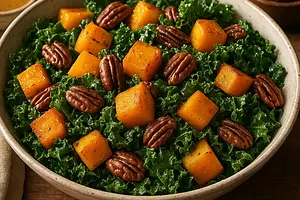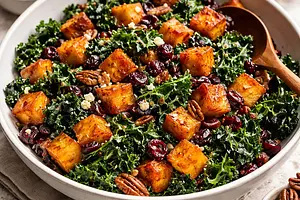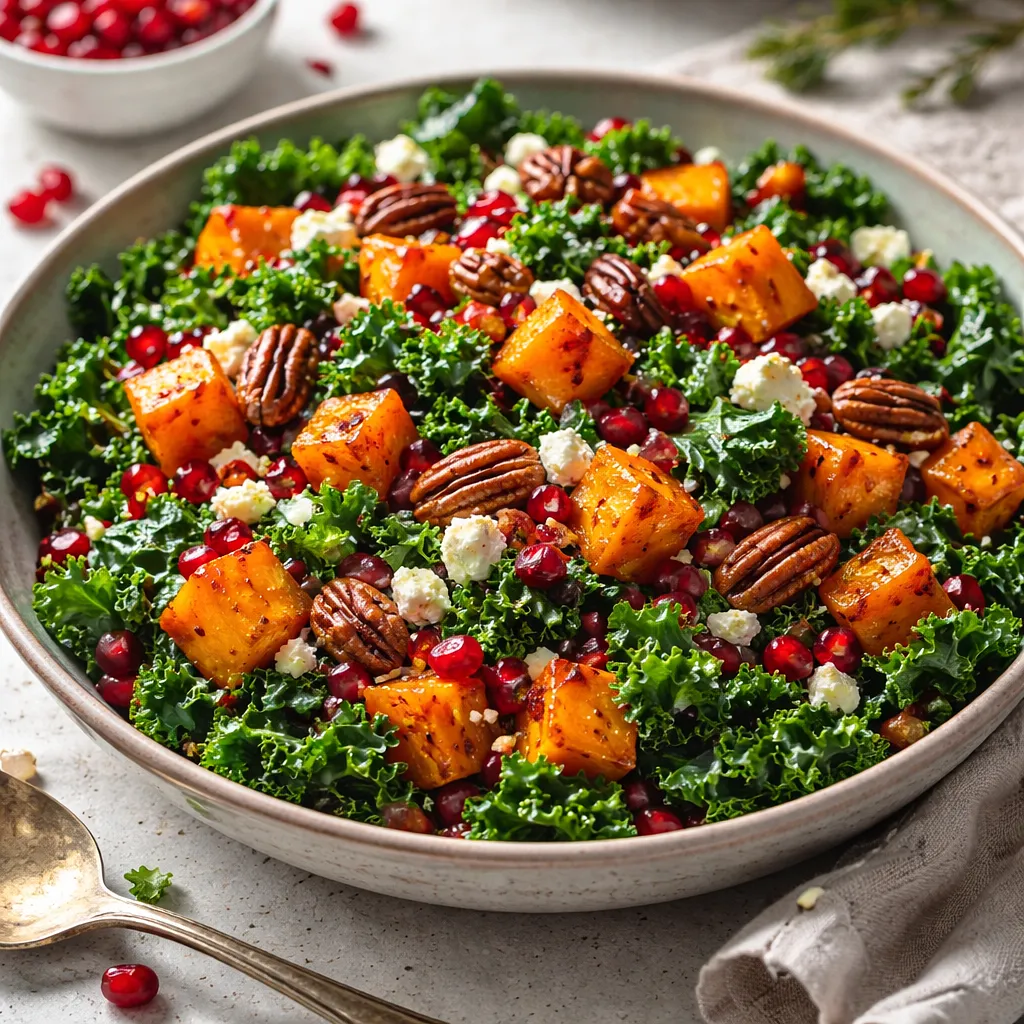
Winter Salad with Roasted Pumpkin, Pomegranate, and Kale

Wegetariańskie Salads Vegetarian Dishes 60 min Medium 12 wyświetleń ~36.61 PLN - (0)
Rate:
(0)
Start Cooking

Description

A colorful, seasonal salad that combines the sweetness of roasted butternut squash, the freshness of kale, and the crunch of radicchio, along with refreshing, tangy accents of pomegranate and mandarin. The dish is inspired by Mediterranean cuisine and the winter flavors of cooler climate regions. Perfect as a light lunch, an appetizer on a holiday table, or a side dish to roasted meat. It surprises with contrasts in texture: creamy squash, crunchy nuts, and mild, creamy goat cheese (optional). Serve immediately after preparation, garnished with fresh fennel fronds and mandarin zest for visual effect.

Ingredients (15)

Servings:
4
  • butternut squash 500 g
  • Baby kale 120 g
  • Radicchio 150 g
  • Fennel 1 szt.
  • Pomegranate arils 100 g
  • Clementine 2 szt.
  • Walnuts 80 g
  • Extra virgin olive oil 2 łyżki
  • Honey 15 ml
  • Dijon mustard 10 g
  • Red wine vinegar 2 łyżki
  • Sea salt 2 g
  • 🌿 Przyprawy
  • Black pepper 2 szczypty
  • ✨ Opcjonalne
  • Soft goat cheese 100 g
  • Pomegranate molasses 2 łyżki
💰 Szacowany koszt dania: ~36.61 PLN (9.15 PLN/porcję)

💡 Kliknij na składnik aby oznaczyć jako użyty

Preparation steps

Roasted vegetables

1

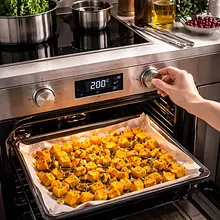
Preheat the oven to 200°C (top-bottom) with the convection option, if you have it. Prepare a baking sheet lined with parchment paper. Peel the butternut squash with a fork or knife, cut it in half, remove the seeds with a spoon, and then cut the flesh into cubes about 2 cm on each side (uniform pieces bake evenly). Place the squash pieces on the baking sheet in a single layer — do not stack them.

Ingredients: butternut squash, Extra virgin olive oil, Sea salt, Black pepper
Use a sharp kitchen knife and a stable cutting board. If the pumpkin is slippery, cut the pieces while holding them with your hand in a kitchen glove. The best tray is flat with a low edge — do not use a deep dish, as the pieces will steam more than bake.
2

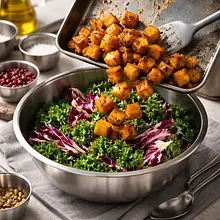
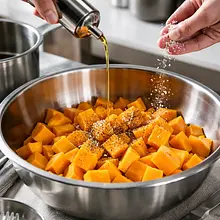
Drizzle the chopped pumpkin with 15 g of oil (1 tablespoon) and evenly sprinkle with 1 pinch of salt and 1 pinch of pepper. Using your hands or a silicone spatula, thoroughly coat the pieces. Bake for 25–30 minutes on the middle rack of the oven: after 15 minutes, take out the tray and stir the pieces to ensure even browning. The pumpkin is ready when the edges are golden and a fork easily pierces the piece (the flesh should be soft but not falling apart).

Ingredients: butternut squash, Extra virgin olive oil, Sea salt, Black pepper
It's best to arrange the pumpkin in a single layer — if the baking tray is too crowded, bake in two batches. If you prefer a more caramelized pumpkin, you can increase the temperature to 210°C for the last 5 minutes. Don't bake too long, as it will become mushy.

Roasting nuts

3

While the pumpkin is baking, heat a dry skillet over medium heat. Add the walnuts and toast for 5–7 minutes, shaking the skillet often or stirring with a wooden spoon, until you can smell the nutty aroma and see a light golden color. Be careful — the nuts can burn quickly. After toasting, transfer them to a plate to cool.

Ingredients: Walnuts
You can also roast the nuts in the oven with the pumpkin for the last 6–8 minutes, spreading them out on a separate baking sheet. Use a cast iron or non-stick skillet for even roasting.

Preparation of raw vegetables

4

Wash the kale and radicchio in cold water and dry in a salad spinner or thoroughly with paper towels. Remove the thick stems from the kale (they can be cut off with a knife). Tear the radicchio leaves into bite-sized pieces. Place the kale in a large bowl and gently "massage" in 1/2 tablespoon of olive oil and a pinch of salt for about 1–2 minutes — the leaves will become softer and less fibrous.

Ingredients: Baby kale, Radicchio, Extra virgin olive oil, Sea salt
Amateur mistakes: don't neglect massaging the kale — without this, it may be too tough. Use your hands or two tablespoons for massaging. If you don't have a salad spinner, dry the leaves with paper towels, gently squeezing them.

Plastering and decorations

5

Trim the outer fibers of the fennel, cut the base, and slice the bulb thinly at an angle (use a mandoline or a sharp knife). Keep the green fronds for decoration. Cut the mandarins into segments: first, trim the skin from the top and bottom, remove the white pith from the sides, and extract the clean segments (the 'supreming' technique). Collect the mandarin juices in a small bowl — they will be useful for the dressing.

Ingredients: Fennel, Clementine
Use a mandoline carefully or a thin, sharp knife to get even slices of fennel. When supreming, hold the fruit over a bowl to catch the juice.

Preparing the pomegranate

6

Cut the pomegranate in half. Holding one half over a bowl, hit the skin with a wooden spoon to release the arils (seeds) into the bowl. Alternatively, cut the pomegranate into quarters and submerge the halves in a bowl of water — the seeds will sink to the bottom, and the white membrane will float to the surface (remove it). Drain the arils and keep the clear juice.

Ingredients: Pomegranate arils
The water method is less messy and safer — use gloves if you don't want to get stained from pomegranate juice. Try not to damage the seeds with your fingers so they remain firm.

Sauce

7

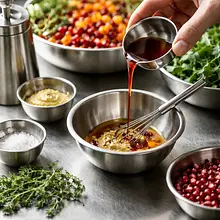
In a small bowl or jar, combine 30 g of olive oil (2 tablespoons), 30 g of red wine vinegar (2 tablespoons), 10 g of Dijon mustard (2 teaspoons), 15 g of honey (1 tablespoon), along with a pinch of salt and a pinch of freshly ground pepper. Add 1–2 tablespoons (15–30 g) of the mandarin juice you collected. Whisk vigorously or shake the jar for 20–30 seconds until a smooth, slightly emulsifying consistency is achieved. If using pomegranate molasses (optional), add 15–30 g and mix gently — this will give a darker color and deeper flavor.

Ingredients: Extra virgin olive oil, Red wine vinegar, Dijon mustard, Honey, Clementine, Pomegranate molasses
Use a small jar with a lid for easy emulsifying (shake for 30 seconds). If you want a more acidic dressing, add an extra 1 tablespoon of vinegar. For a vegan version, substitute honey with maple syrup.

Salad Assembly

8

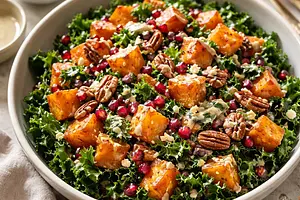
When the pumpkin is roasted and slightly cooled (it should be warm, not hot), place the kale and radicchio in a large bowl. Add the slices of fennel, segments of mandarin, toasted walnuts, and pomegranate arils. Finally, add the pieces of roasted pumpkin. Drizzle with the prepared dressing gradually: start with 2/3 of the amount, gently toss with tongs or two large spoons, taste, and if necessary, add more dressing. The salad should be evenly coated but not soaked in the dressing.

Ingredients: Baby kale, Radicchio, Fennel, Clementine, Pomegranate arils, butternut squash, Walnuts, Extra virgin olive oil, Sea salt, Black pepper
Use a large mixing bowl and wooden tongs or two spoons to gently combine the ingredients — do not mash the roasted pumpkin. Add the dressing gradually, as the leaves absorb the liquids and it’s easy to overdo it.

Finishing and serving

9

Transfer the salad to a serving platter or portion it into individual bowls. Crumble goat cheese on top (if using) evenly — about 100 g in total. Sprinkle the salad with fresh fennel fronds and optionally a bit of mandarin zest for aroma. If you are using pomegranate molasses, decorate the plate with thin lines of molasses for visual effect.

Ingredients: Soft goat cheese, Pomegranate molasses, Fennel
Serve immediately — the salad tastes best when the pumpkin is still slightly warm. Use a wide spoon and fork for serving to avoid breaking the pumpkin pieces. Alternatively, arrange the ingredients artistically on a large flat plate.

Final tips

10

Before serving, taste the salad and season to taste with additional salt, freshly ground pepper, or a few drops of oil. If the salad seems dry, add the remaining dressing. Serve with crispy bread or as a side dish to white meat.

Ingredients: Extra virgin olive oil, Sea salt, Black pepper
A common mistake: adding too much dressing at the beginning — always season gradually. If you're preparing the salad in advance, keep the dressing and toasted nuts separate to maintain texture.

Fun Fact

💡

Pomegranates were symbols of fertility and abundance in ancient times; in Middle Eastern cuisine, they are often combined with pumpkin and dill for a contrast of flavors.

Best for

Tips

🍽️ Serving

Serve the salad slightly warm — roasted pumpkin pairs best with cool leaves. For visual effect, use a white platter to contrast with the red of the pomegranate and the orange of the pumpkin. Serve with dark rye bread or crispy croutons.

🥡 Storage

Store toasted nuts and dressing separately in the fridge for 2–3 days. The combined salad can be stored for a maximum of 24 hours in an airtight container — the pumpkin will become soft over time, and the leaves will lose their crunch. Heat the pumpkin separately in the oven for 5–7 minutes at 160°C before combining again.

📸 Ugotowane przez społeczność

Zaloguj się, aby dodać zdjęcie
Dodaj zdjęcie gotowej potrawy

Po zatwierdzeniu przez moderatora otrzymasz 10 punktów doświadczenia.

🍲

Nikt jeszcze nie dodał zdjęcia. Bądź pierwszy!

Comments (0)

Be the first to comment on this recipe!

Add a comment

You might also like

Recipe Categories

Salads
Salads in: Valentine's Day

Fresh and healthy salads that will be a perfect complement to a Valentine's Day dinner.

See all recipes in this category

Vegetarian cuisine is a wealth of flavors without meat - healthy, colorful, and filling. Plant-based proteins: lentils, chickpeas, beans, peas, and soy take center stage. Cheeses and dairy: feta, halloumi, ricotta, and mascarpone in main dishes. Eggs in various forms: omelets, frittata, shakshuka...

See all recipes in this category
Reklama