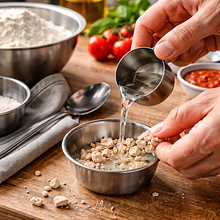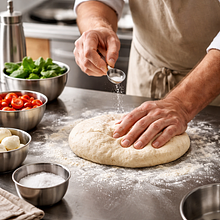
Prepare all the ingredients (mise en place): measure the flour, heat the water to about 35-38°C (it should feel pleasantly warm to the touch of your wrist), drain the mozzarella from the brine and cut it into slices or tear it by hand. Lay out the tools on the counter: a large bowl, a kitchen scale, a spoon, a bowl for activating the yeast, plastic wrap or a damp cloth, a dough scraper, and a baking sheet/pizza stone.
Description
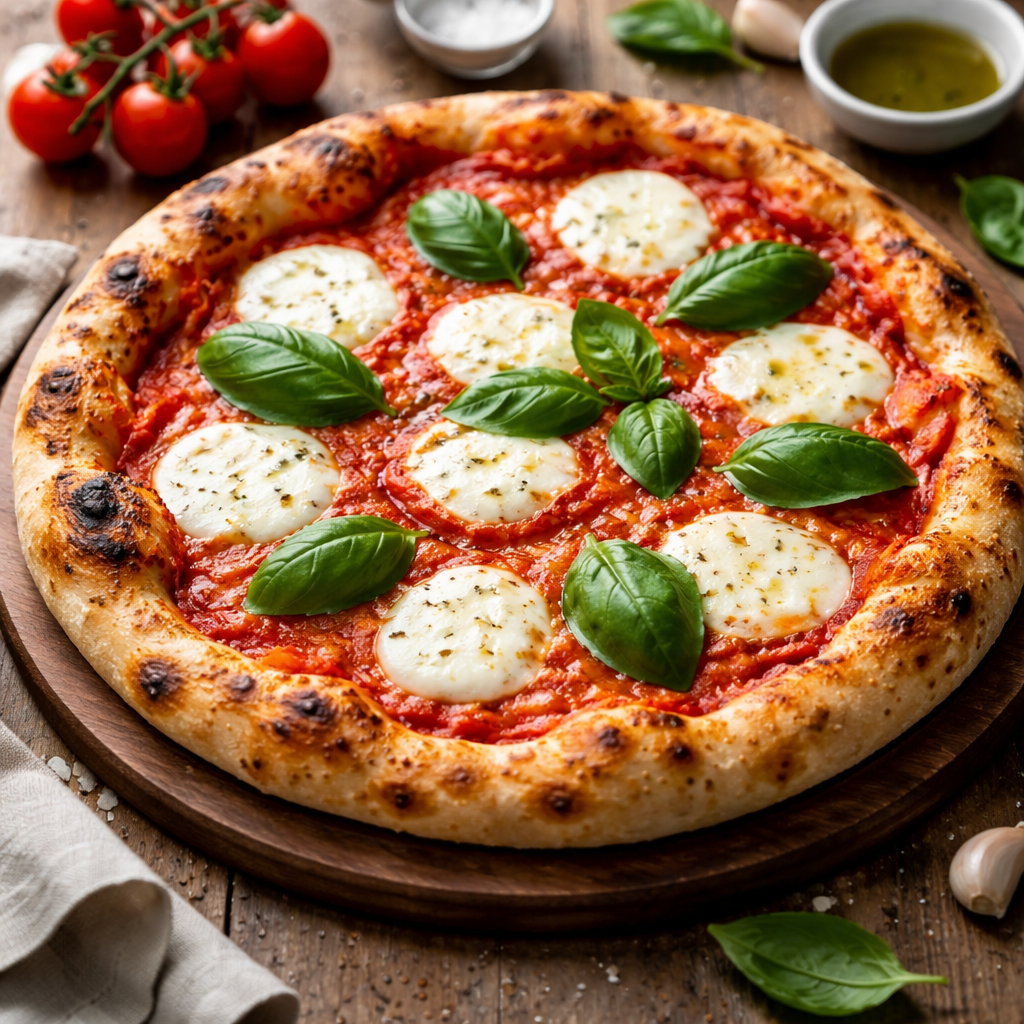
Classic Pizza Margherita is a simple yet exceptionally aromatic pizza originating from Naples — thin, slightly puffed dough, sauce made from ripe tomatoes, melting mozzarella, and fresh basil leaves. This dish is characterized by the contrast of a soft, moist center and a crispy edge, along with the freshness of the herbs. Serve as a main dish for 2–4 people (depending on appetite) or as part of an Italian menu with arugula and extra virgin olive oil. It looks aesthetically pleasing on a stone base with lightly browned edges, and the flavor is a combination of the acidity of the tomato, creamy mozzarella, and the aroma of basil.
Ingredients (11)
- Type 00 wheat flour 500 g
- Water 325 ml
- Fresh yeast 15 g
- Extra virgin olive oil 0.2 łyżek
- Tomato passata (purée) 400 g
- Garlic 2 ząbki
- Fior di latte mozzarella 400 g
- 🌿 Przyprawy
- Salt 10 g
- Fresh basil 0.3 pęczków
- ✨ Opcjonalne
- Parmesan (optional) 40 g
- Dried oregano (optional) 1 łyżeczka
💡 Kliknij na składnik aby oznaczyć jako użyty
Preparation steps
Preparation
Cake
Activate the yeast: crumble fresh yeast into a small bowl, pour in 50 ml of warm water (from the total of 325 ml), and mix until the yeast dissolves. Set aside for 5–7 minutes — a light foam or the smell of yeast should appear on the surface, indicating their activity.
Pour the flour into a large bowl and make a well in the center. Pour in the dissolved yeast and gradually add the rest of the warm water (about 275 ml), mixing with a fork or wooden spoon only in the middle until a loose, irregular mixture forms. Add the oil (15 g from the specified amount) and mix lightly.
Add salt (10 g) and start kneading the dough: if you are doing it by hand, place the mixture on a lightly floured surface and knead vigorously for 8–10 minutes until the dough becomes smooth and elastic. If you are using a mixer, knead on medium speed with a hook for 6–8 minutes. The dough is ready when it stops sticking heavily to your hands and is elastic — it should spring back slightly when pressed with a finger.
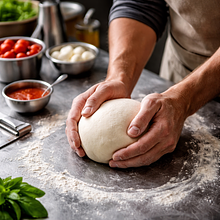
Form a ball from the dough: smooth the surface with your hand while turning the dough underneath to create a taut skin. Grease the inside of a large bowl with a bit of oil (the remainder from 30 g) and place the ball in the bowl. Cover with plastic wrap or a damp cloth and set aside in a warm place (about 24°C) for 90–120 minutes, until the dough doubles in volume.
Tomato sauce
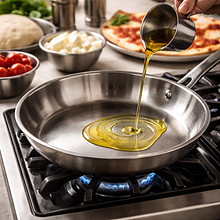
Prepare the sauce: heat a pan over medium heat, pour in 10 g of oil (part of the previously measured amount), add finely chopped garlic (2 cloves = 10 g) and sauté for 30–45 seconds until it becomes fragrant — do not brown. Pour in the passata (400 g), season with 3–5 g of salt (about half a teaspoon) and simmer for 8–12 minutes until the sauce thickens slightly. Finally, you can add a teaspoon of dried oregano (optional).
Shaping and dividing the dough
After the dough has risen, transfer it to a lightly floured surface. Gently deflate the dough by pressing down twice (do not knead vigorously). Divide the dough into 4 equal parts using a knife or spatula. Shape each part into a ball: pinch the bottom, turn it over, and smooth it out to create a taut surface. Cover the balls with a cloth and let them rest for 15–20 minutes for a short "rest" (easier stretching).
Stretching the dough
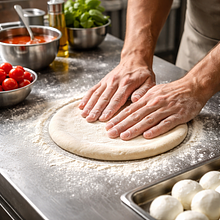
Take one ball, dust the countertop with a little flour, and flatten the ball with your fingers into a circle about 15 cm in diameter, leaving a thicker edge. Then, using your fingers, stretch the dough from the center outwards — slide your hands under the dough and gently rotate it until you achieve a diameter of about 28–30 cm. Avoid using a rolling pin, as it will kill the air structures; do this by hand, gently stretching the center. The center should be thin, and the edge should be fluffy.
Assembling the pizza
Spread 2–3 tablespoons (about 100 g) of the prepared tomato sauce on the stretched dough — use a spoon to evenly distribute the sauce from the center towards the edges, leaving a 1–2 cm border. Arrange slices or torn pieces of mozzarella evenly in the center, leaving the edges slightly exposed.
Baking
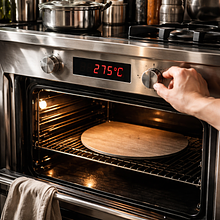
Preheat the oven to the maximum temperature (250–275°C). If you have a pizza stone or steel, place it in the oven and heat for at least 30–45 minutes. When transferring the pizza to the stone, use a peel dusted with flour or semolina. Bake the pizza on the stone or on a hot baking sheet for 6–10 minutes, until the edges are golden and slightly charred, and the cheese is melted and bubbly. In a home oven without a stone, use the convection setting and the highest temperature; bake for about 8–12 minutes.
Finishing
After removing the pizza from the oven, immediately place a few fresh basil leaves (10 g) on the hot cheese — the heat will release the aroma. If you are using Parmesan (optional), grate it fresh and sprinkle a thin layer on top. Drizzle with a little extra virgin olive oil (optional). Cut the pizza into 4 pieces using a pizza cutter or a large knife.
Serving
Serve the pizza hot, directly after baking. Additionally, place parmesan and fresh basil on the table for those who want it. Pizza Margherita tastes best when eaten right away, while the crust is crispy and the cheese is still gooey.
Fun Fact
Pizza Margherita was popularized in Naples in the 19th century and according to a popular story, it was named after Queen Margherita of Savoy — its colors (red sauce, white cheese, green basil) were meant to symbolize the Italian flag.
Best for
Tips
Serve the pizza immediately after baking. For a contrast of flavors, add arugula and thin slices of prosciutto (optional) on the hot pizza just before serving, or serve with a light salad of arugula, cherry tomatoes, and parmesan. For a spicier aroma, season with a pinch of chili flakes.
Store leftovers in the refrigerator for up to 24 hours in an airtight container. To reheat, place the pizza on a heated skillet or in the oven at 200°C for 5–8 minutes, until the crust regains its crispiness. Avoid the microwave (the crust will become soft). The dough can also be fermented in the refrigerator for 24–48 hours — in this case, divide the ingredients and make the dough in the evening, then after the first rise, chill in the refrigerator, take it out, and shape into balls in the morning before baking.
📸 Ugotowane przez społeczność
Zaloguj się, aby dodać zdjęcieDodaj zdjęcie gotowej potrawy
Po zatwierdzeniu przez moderatora otrzymasz 10 punktów doświadczenia.
Nikt jeszcze nie dodał zdjęcia. Bądź pierwszy!
Comments (0)
Be the first to comment on this recipe!
Add a comment