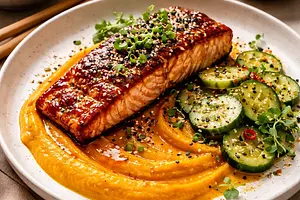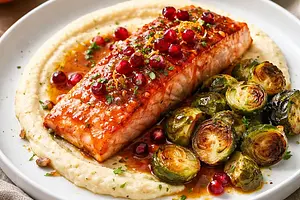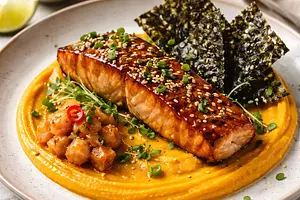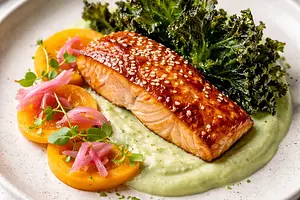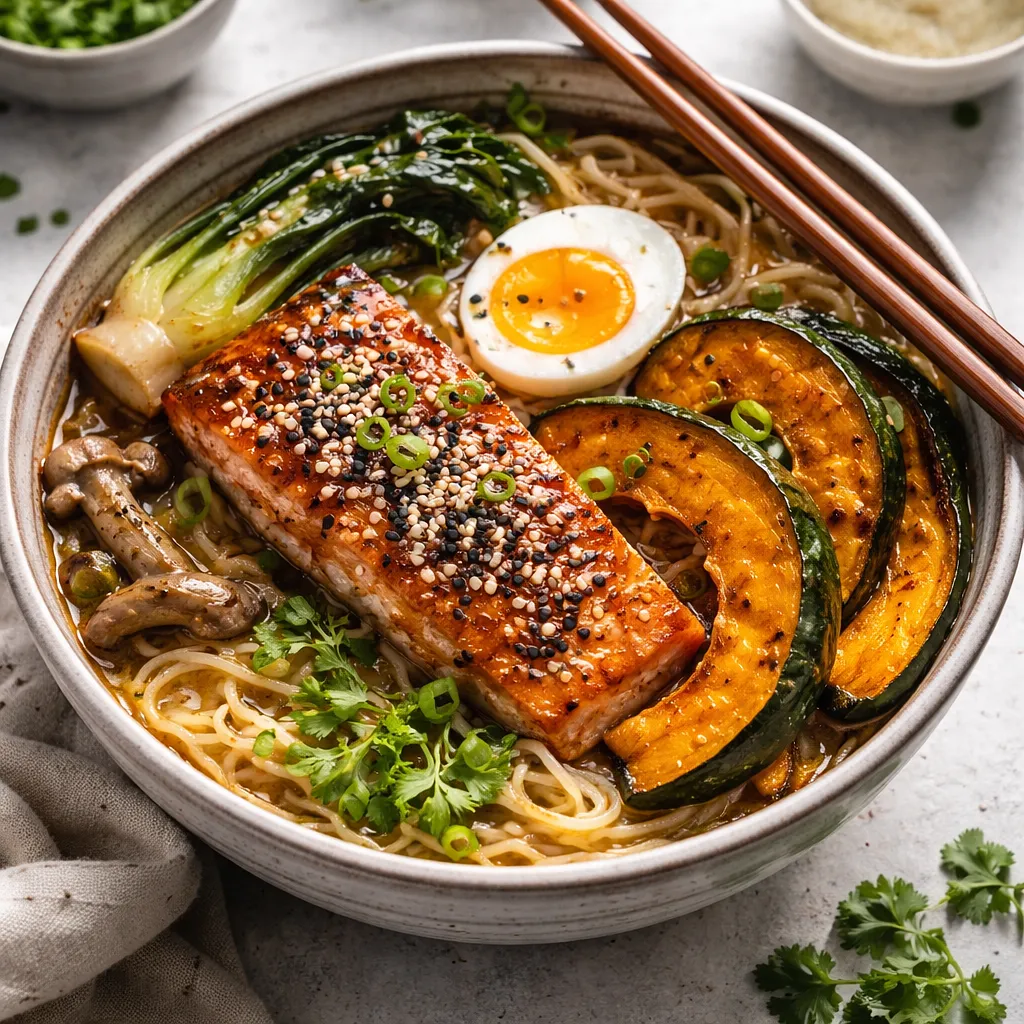
Winter miso-ramen fusion with roasted kabocha squash and glazed salmon

Pikantne Asian Fusion Cuisine Main dishes 90 min Medium 6 wyświetleń ~55.61 PLN - (0)
Rate:
(0)
Start Cooking

Description

A seasonal, aromatic dish that combines the Japanese delicacy of miso ramen with the rustic European way of preparing pumpkin. The soup is based on a clear dashi made from dried shiitake and kombu, enriched with white miso and ginger. We add chewy ramen noodles to the miso broth, and the dish is garnished with caramelized pieces of kabocha pumpkin and a crispy, sweet-salty glazed salmon fillet. Completing the dish are quick pickles made from daikon, fresh chives, and optional strips of nori and toasted sesame, which provide a contrast of textures and an intense appearance. The dish has a rich palette of flavors (umami from miso and shiitake, sweetness from the pumpkin, saltiness from the soy sauce, and the delicate fattiness of the salmon) and is visually striking with its vibrant colors — deep orange pumpkin, pink salmon, green chives, and white ribbons of pickled daikon. Perfect for winter dinners or as an impressive offering for a fusion-style gathering.

Ingredients Used

Ingredients (20)

Servings:
4
  • Salmon fillet 600 g
  • Kabocha squash (flesh) 800 g
  • Dried ramen noodles 400 g
  • White miso (shiro miso) 100 g
  • Dried shiitake mushrooms 30 g
  • Dried Kombu 5 g
  • Water 1600 ml
  • Fresh ginger 20 g
  • Garlic 3 ząbki
  • Soy sauce 60 ml
  • Mirin 40 ml
  • Sesame oil 15 ml
  • Rapeseed oil (for baking/frying) 2 łyżki
  • Green onion (scallion) 2 pęczki
  • Daikon (white radish) for pickling 150 g
  • Sugar (for daikon marinade and glaze) 20 g
  • 🌿 Przyprawy
  • Salt 0.1 szczypt
  • Black pepper (ground) 2 szczypty
  • ✨ Opcjonalne
  • Nori (strips, optional) 5 g
  • Toasted white sesame seeds (optional) 10 g
💰 Szacowany koszt dania: ~55.61 PLN (13.90 PLN/porcję)

💡 Kliknij na składnik aby oznaczyć jako użyty

Preparation steps

Preparation of dried ingredients

1

Place the dried shiitake mushrooms (30 g) in a bowl and cover with 200 ml of hot water; let sit for 25-30 minutes until the mushrooms soften and release their flavor. After soaking, remove the mushrooms, squeeze them out, slice into strips, and reserve the soaking water. In a separate medium pot, place the kombu (5 g) and 400 ml of cold water; let sit for 15-20 minutes (this can be done in advance), then slowly heat over medium heat until just before boiling — small bubbles will appear. Remove the kombu before boiling.

Ingredients: Dried shiitake mushrooms, Dried Kombu, Water
Use a ceramic or glass bowl to soak the shiitake. A wide, flat pot is best for heating the kombu. Do not let the kombu boil — cooking it will cause a bitter taste.
Miso-dashi broth

2

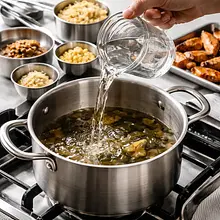
In the pot with kombu water, add an additional 400 ml of water (a total of 800 ml with kombu) and the reserved water from the shiitake (about 200 ml). Add grated ginger (20 g) and 1 clove of garlic (5 g, lightly crushed). Bring to a gentle boil over medium heat, then reduce the heat and simmer for 8-10 minutes to allow the flavors to meld. Turn off the heat and let it sit for 2 minutes, then spread the white miso (100 g) in a small bowl, mixing it with 100 ml of hot broth to form a smooth paste, and then pour it back into the pot. Do not boil the broth after adding the miso — prolonged cooking will destroy the fresh flavors of the miso.

Ingredients: Dried Kombu, Water, Dried shiitake mushrooms, Fresh ginger, Garlic, White miso (shiro miso)
Use a slotted spoon to remove the kombu before boiling. To dissolve the miso, use a metal spoon or ladle; miso dissolves best in hot (but not boiling) liquid. This is a key step: the broth should be aromatic but not boiling after adding the miso.

Quick Pickles with Daikon

3

Slice the daikon (150 g) into thin half-moons or ribbons about 2-3 mm thick. In a saucepan, heat 60 ml of water, add 20 g of sugar and 10 g of salt (about 10 g of salt is a larger amount; in this recipe, we use 3 g as a pinch of salt to taste — add 3 g). Heat until the sugar dissolves, then remove from heat and pour in 40 ml of rice vinegar (if you don't have it, use white wine vinegar). Pour the hot marinade over the daikon slices and let sit for at least 15 minutes. After 15 minutes, the daikon will be crunchy and slightly sour — the perfect contrast to the creamy broth.

Ingredients: Daikon (white radish) for pickling, Sugar (for daikon marinade and glaze), Salt, Water
Use a sharp knife or mandoline to slice the daikon thinly — even thickness will ensure even pickling. If you don't have rice vinegar, substitute 1:1 with white wine and a little sugar.

Preparing kabocha squash

4

Preheat the oven to 200°C (top-bottom). Wash the kabocha squash (800 g), cut it in half and scoop out the seeds (you can save them for roasting). Cut the flesh into wedges about 1.5 cm thick (with the skin on). In a large bowl, drizzle the pieces with 15 g of canola oil, sprinkle with 1 g of salt and 1 g of pepper. Arrange the pieces on a baking sheet lined with parchment paper, skin side down, and bake for 25-30 minutes, until the edges are golden and the flesh is soft (check with a fork — it should go in easily). After 20 minutes, drizzle the squash with 20 g of mirin mixed with 10 g of soy sauce and put it back in for another 5-10 minutes to caramelize.

Ingredients: Kabocha squash (flesh), Rapeseed oil (for baking/frying), Mirin, Soy sauce, Salt, Black pepper (ground)
Use a large baking sheet and do not place the pieces too tightly — air must circulate for the pumpkin to caramelize. If the pumpkin has a very hard skin, bake for 30-35 minutes. The flesh is ready when a fork goes in easily and the edges are slightly golden.

Glazing the salmon

5

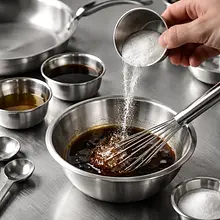
Prepare the glaze: in a small bowl, mix 20 g of soy sauce, 20 g of mirin, and 10 g of sugar. Brush the salmon fillets (600 g) on both sides with it. Heat a pan (preferably non-stick) over medium-high heat with 1 teaspoon (5 g) of canola oil. Place the salmon skin-side down and fry for 3-4 minutes until the skin is crispy. Flip and fry for 2-3 minutes on the other side, reduce the heat, and 1 minute before the end, brush the salmon with the glaze, reducing it to a sticky shine. Alternatively, you can bake the salmon in the oven at 200°C for 8-10 minutes, brushing with the glaze 2-3 minutes before the end.

Ingredients: Salmon fillet, Soy sauce, Mirin, Sugar (for daikon marinade and glaze), Rapeseed oil (for baking/frying)
Use a wide non-stick skillet. Do not overcook the salmon — it should be slightly pink in the middle and juicy. If the fillet has skin, start with the skin side to achieve crispiness.

Cooking pasta

6

In a large pot, bring 2 liters of water to a boil (do not salt heavily — the broth is salty). Add the ramen noodles (400 g) and cook according to the package instructions (usually 3-4 minutes) until al dente — firm and slightly springy in the center. Drain and briefly rinse with cold water only if you want to stop the cooking process (for ramen, it's best to drain and immediately transfer to bowls).

Ingredients: Dried ramen noodles, Water
Use a large pot — the pasta needs space to cook freely. Do not overcook the pasta; it should be firm when it goes into the hot broth.

Finishing the broth

7

After adding the miso and letting the broth sit, taste it and season gently with 2-3 g of salt (a pinch) and a little pepper (2 g). If the broth is too strong, dilute it with warm water (50-100 ml). Finally, add 10 g of sesame oil for flavor and mix.

Ingredients: White miso (shiro miso), Salt, Black pepper (ground), Sesame oil, Water
Add salt gradually, as soy sauce and miso already provide saltiness. Add sesame oil at the end to preserve its aroma.

Heating and assembling the ingredients

8

Slice the spring onion (60 g) into thin rings — leave the white ends for cooking, and use the green parts for garnish. Warm the kabocha squash pieces if needed (short 2-3 minutes in the oven or on a hot pan) and cut the glazed salmon into portioned pieces (about 4 portions of 150 g each). Prepare four wide bowls. In each bowl, place an equal portion of noodles (100 g), divide the broth (about 350-400 ml per bowl), and top with 2-3 pieces of squash, slices of glazed salmon, a tablespoon of pickled daikon, sprinkle with spring onion, and (optional) strips of nori and toasted sesame seeds. Finally, drizzle each bowl with 1-2 g of sesame oil for flavor.

Ingredients: Dried ramen noodles, Water, Kabocha squash (flesh), Salmon fillet, Daikon (white radish) for pickling, Green onion (scallion), Nori (strips, optional), Toasted white sesame seeds (optional), Sesame oil
Use large bowls with a capacity of about 600-800 ml, so the soup has room for the ingredients and steam. Arrange the ingredients aesthetically: pumpkin on one side, salmon on the other, daikon and chives in the middle — this will create an eye-catching layout.

Final seasoning and serving

9

Before serving, check the taste of one bowl — if needed, add a few drops of soy sauce or a bit of miso dissolved in a tablespoon of hot broth. Serve hot, immediately after assembling — the pasta should be springy, the salmon juicy, and the pumpkin soft and caramelized. Serve the dish right away to maintain the contrast of temperatures and textures.

Ingredients: Soy sauce, White miso (shiro miso), Salmon fillet, Kabocha squash (flesh)
Use a tablespoon and chopsticks for serving. The dish loses the freshness and crunchiness of the pickles after a while, so serve immediately. Avoid reheating the miso broth.

Fun Fact

💡

Miso has been used in Japan for centuries — traditionally, alongside rice and tea, it forms the basis of the daily diet. The combination of roasted pumpkin (kabocha) with miso enhances the natural sweetness of the vegetable, and it is such pairings that lay the foundation for fusion cuisine.

Best for

Tips

🍽️ Serving

Serve in wide ramen bowls. For visual effect, layer the ingredients: noodles at the bottom, broth filling up to 3/4 of the height, topped with pieces of pumpkin and salmon. Add a few drops of chili oil if you have guests who enjoy spiciness. For drinking, I suggest green tea or a light, dry white wine.

🥡 Storage

Store the broth and ingredients separately in the refrigerator for up to 48 hours (in airtight containers). The glaze and salmon are best eaten the same day; they can be reheated in the oven for 5-7 minutes at 170°C. Store the pasta separately — once combined with the broth, it loses its texture. Daikon pickles can be stored for up to 3 days.

📸 Ugotowane przez społeczność

Zaloguj się, aby dodać zdjęcie
Dodaj zdjęcie gotowej potrawy

Po zatwierdzeniu przez moderatora otrzymasz 10 punktów doświadczenia.

🍲

Nikt jeszcze nie dodał zdjęcia. Bądź pierwszy!

Comments (0)

Be the first to comment on this recipe!

Add a comment

You might also like

Recipe Categories

Modern recipes that combine traditional flavors of Asia with other culinary cultures, offering unusual combinations and innovative dishes.

See all recipes in this category

Main courses are the heart of every meal - hearty, nutritious, and full of flavor. In this category, we present a rich selection of recipes for lunches and dinners that will satisfy even the most discerning palates. From classic Polish pork chops to aromatic chicken dishes, to exquisite steaks an...

See all recipes in this category
Reklama